




by Carol Tran
Winter Bills: Is it cheaper to heat your house with gas or electricity?
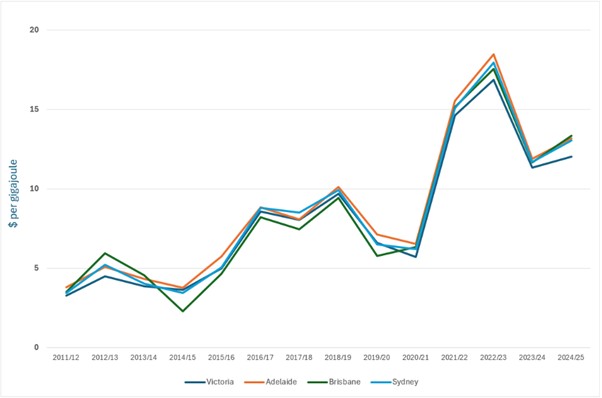
Gas prices in Australia have seen significant fluctuations in recent years, driven by a combination of global market dynamics, domestic supply constraints, and rising demand. As both a major exporter of liquefied natural gas (LNG) and a domestic consumer across residential, commercial, and industrial sectors, Australia’s prices are increasingly influenced by international trends. The east coast market, in particular, has faced upward pressure due to limited infrastructure and competition from export contracts. As of financial year 2024/25, average wholesale gas prices have come down from the 2022/23 peak, but they remain at the third-highest level over the past fifteen years (Figure 1).
Although wholesale prices do not directly affect household power bills, sustained high prices flow through to retail prices in the coming years. For households and businesses, this volatility affects energy costs and decision-making, as consumers increasingly consider alternatives such as electrification and investments in Consumer Energy Resources (CER) in response to rising prices.
Figure 1: Average gas prices $/GJ for the Victorian gas market, STTM hubs in Adelaide, Brisbane and Sydney
Source: Australian Energy Council’s analysis
In Victoria, these price pressures are particularly acute during winter, when gas heating demand peaks. Melbourne households typically see their highest gas bills between June and August, as shorter daylight hours increase electricity use while gas heating surges. The state has the highest rate of residential gas consumption in the country (see Table 1). This heavy reliance on gas heating during the colder months makes Melbourne the most relevant location for examining the economic viability of switching to solar-powered electric alternatives. We will compare household bills using traditional gas heating with those using electric heating systems supported by rooftop solar generation.
Table 1: Natural Gas Consumption (TJ) by residential and small businesses during financial year 2023-24

Source: 2025 Electricity Gas Australia, Australian Energy Council
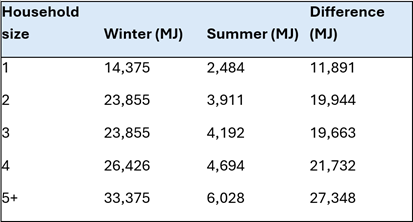
Table 2: Average gas usage in winter and summer by household sizes
Source: Frontier Economics - Simple electricity and gas benchmarks - From June 2021
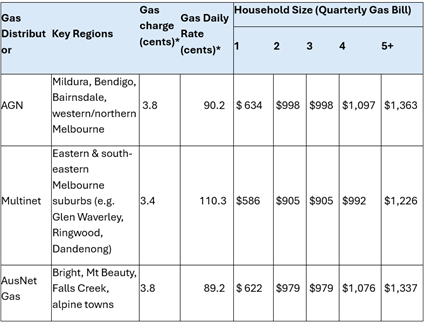
The sharp seasonal difference is primarily due to space heating, as gas use for hot water and cooking remains relatively steady year-round. This highlights that the vast majority of gas consumption in Victorian homes during winter is driven by heating demand, not other appliances. Research by Frontier Economics indicates that for the average family of four, the additional 21,732 MJ consumed during winter can result in a gas bill of roughly $1000. Larger households of five or more typically use 27,348 MJ more during winter, with gas bills exceeding $1,300.
Table 3: Estimated Winter (June, July & August) Gas Bill in Victoria by household sizes
Source: Frontier Economics - Simple electricity and gas benchmarks - From June 2021, Australian Energy Council’s analysis
*Average rate of all gas retailers across different gas distributor regions
*Many gas retailers use tiered pricing (e.g. different rates for the first 27 MJ). For simplicity, a flat rate (c/MJ) is assumed in this analysis.
While the gas market is competitive, many consumers focus on switching electricity plans rather than gas, often leaving money on the table with their gas bills. One way to reduce the impact of high winter gas bills is to consider electric heating alternatives, particularly those powered by energy-efficient appliances or rooftop solar systems.
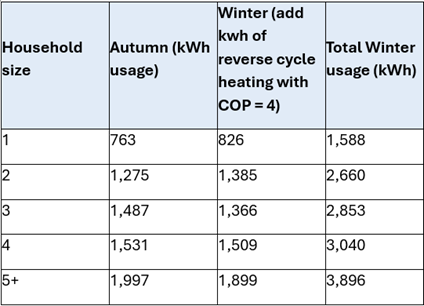
To fairly compare gas and electric heating costs, we first estimate the electricity required to deliver the same amount of heat currently provided by gas during winter. This depends on the efficiency of electric heating systems, with reverse-cycle air conditioners among the most efficient. A reverse-cycle system has a coefficient of performance (COP) of 3–5, delivering 3 to 5 units of heat for every unit of electricity consumed. Using this efficiency factor, household gas consumption (in MJ) can be converted into the equivalent electricity demand (in kWh) needed to provide the same level of heating.
To establish an accurate baseline for electricity use without heating or cooling loads, this analysis uses autumn consumption data. Autumn in Melbourne requires minimal space heating or air conditioning, reflecting true household electricity use for lighting, appliances, and hot water. Unlike spring, autumn’s lower solar generation avoids artificially reduced consumption from the 35–40 per cent of Victorian households with existing solar systems. The converted gas heating demand is then added to this autumn baseline to estimate total winter electricity requirements for households switching to electric heating.
Table 4: Estimated total winter electricity usage in Victoria
Source: Frontier Economics - Simple electricity and gas benchmarks - From June 2021, Australian Energy Council’s analysis
Note: Total = autumn electricity usage + converted gas usage for heating into electricity (from MJ into kWh)
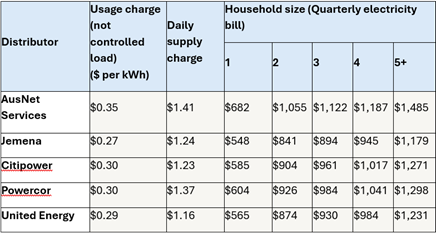
As shown in Table 5, even without solar, electricity bills are already competitive with gas for many household sizes, particularly in lower-cost distribution regions such as Jemena or United Energy.
Table 5: Estimated Winter (June, July & August) Electricity Bill in Victoria by household sizes
Source: ESC, Australian Energy Council’s analysis
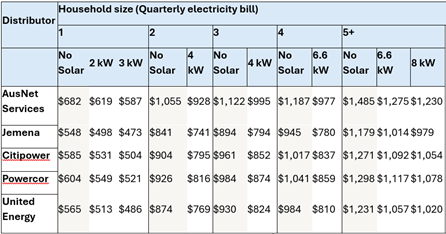
While reverse-cycle electric heating is already comparable in cost to gas for many households, adding a solar PV system can reduce quarterly electricity bills even further across all household sizes. Table 6 shows the potential savings for Victorian families. Single-person households typically need around 3 kW of solar panels to reduce their winter bills to $473–$587, while larger households generally require 6.6–8 kW systems for the greatest savings.
Table 6: Estimated Winter (June, July & August) Electricity Bill with rooftop solar systems in Victoria by household sizes
Source: ESC, Australian Energy Council’s analysis
While ongoing energy costs are clearly reduced, households should be mindful of the initial capital investment required to install rooftop solar or upgrade to reverse-cycle heating systems, which can vary depending on system size, existing infrastructure, and available rebates. The latest federal battery rebate scheme further strengthens the economic case, allowing households to store excess solar and reduce their winter electricity bills even more.
This article is an extract from the Australian Energy Council’s Solar Report Q2 2025. For the full analysis and detailed data, see the complete report here.
Related Analysis
Beyond the Rules: Lessons from the UK on Supporting Energy Consumers Experiencing Vulnerability
Customer vulnerability in the energy sector rarely follows a predictable path, often emerging through financial pressure, illness or sudden life disruption. The United Kingdom’s experience shows that early intervention, flexible support, trusted communication and coordinated care can significantly improve outcomes for households at risk. We explore what Australia can learn from the UK’s evolving approach to supporting customers experiencing vulnerability.
Where’s the energy for new gas generation?
The importance of gas-powered generation (GPG) to our energy system is well recognised, with system planners and market operators often seeing it as an essential “last line of defence.” The role of gas generation has been further highlighted by two recent papers: the Australian Energy Council’s Energy2050 Vision for the Future Energy System and the policy paper “Are gas turbines ‘bankable’ in energy-only markets?” published by Griffith and Cambridge Universities. Despite this clear and ongoing need, investment in new gas-fired generation remains limited, raising important questions about market settings, policy signals and the future role of dispatchable capacity in a transitioning grid — we take a look.
Addressing Energy Affordability Needs More Than Short-Term Relief
The conflict in the Middle East has continued to highlight the challenges we face in ensuring energy supply remains accessible and affordable for everyone. Ensuring Australia becomes more resilient to international energy price shocks will dominate the energy policy landscape for some time, and rightfully so. But while political debate often gravitates toward regulatory interventions and subsidies that deliver short term household bill relief, the real solution lies in something far more complex: reshaping how the energy system works for consumers. What’s increasingly clear is that energy affordability is not just about price - it’s about design. That is why the AEC is releasing its Affordability Action Agenda today – an 8-point plan of critical actions that industry and governments need to take to ensure that energy remains accessible and affordable for all Australians. Read more.
Send an email with your question or comment, and include your name and a short message and we'll get back to you shortly.