




by Tom Monaghan
What’s behind the bill? Unpacking the cost components of household electricity bills
With ongoing scrutiny of household energy costs and more recently retail costs, it is timely to revisit the structure of electricity bills and the cost components that drive them. While price trends often attract public attention, the composition of a bill reflects a mix of wholesale market outcomes, regulated network charges, environmental policy costs, and retailer operating expenses.
Understanding what goes into an energy bill helps make sense of why prices vary between regions and how default and market offers are set. Below, we break down the main cost components of a typical residential electricity bill and look at how customers can use comparison tools to check if they’re on the right plan.
The energy bill cost stack
Household energy bills are made up of several different components, with costs varying from state-to-state depending on things like the types of generation sources, the market size, the network area, and the state-based green schemes. Bills will also vary depending on the retailer and energy plan chosen. To understand energy power bills, it is important to understand what goes into them.
Broadly, energy bills cover four types of costs:
- Wholesale
- Network
- Retail
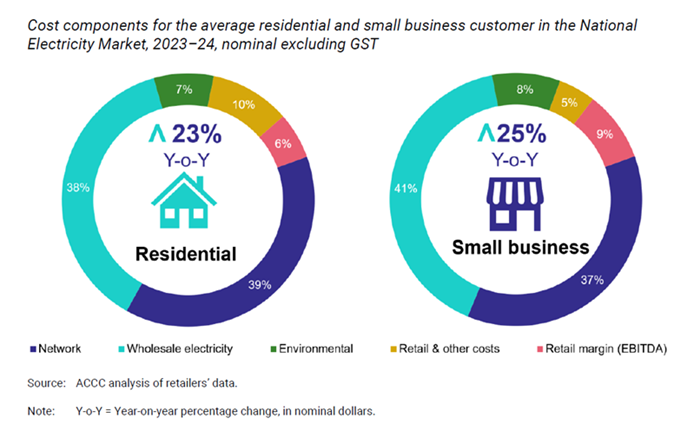
Figure 1 below is the most recent breakdown by the Australian Competition and Consumer Commission in its ongoing inquiry into National Electricity Market of the components of electricity bills for households and small businesses.
Figure 1: Breakdown of the cost components of an average electricity bill in the NEM for 2023-24
Source: ACCC, Inquiry into the National Electricity Market: December 2024 Report
The average residential bill in the National Electricity Market (NEM) in the 2023-24 financial year was $1842. For small business the average bill was $4569 in the same period. Prices in calendar year 2024 fell compared to a year earlier. More recently we have seen announcements of increases in bills. In its final determination of the Default Market Offer (DMO) that comes into effect 1 July the Australian Energy Regulator has pointed to increases across nearly every component of the DMO (see regulated prices section below). The make-up of the average residential bill is explained in the table below.
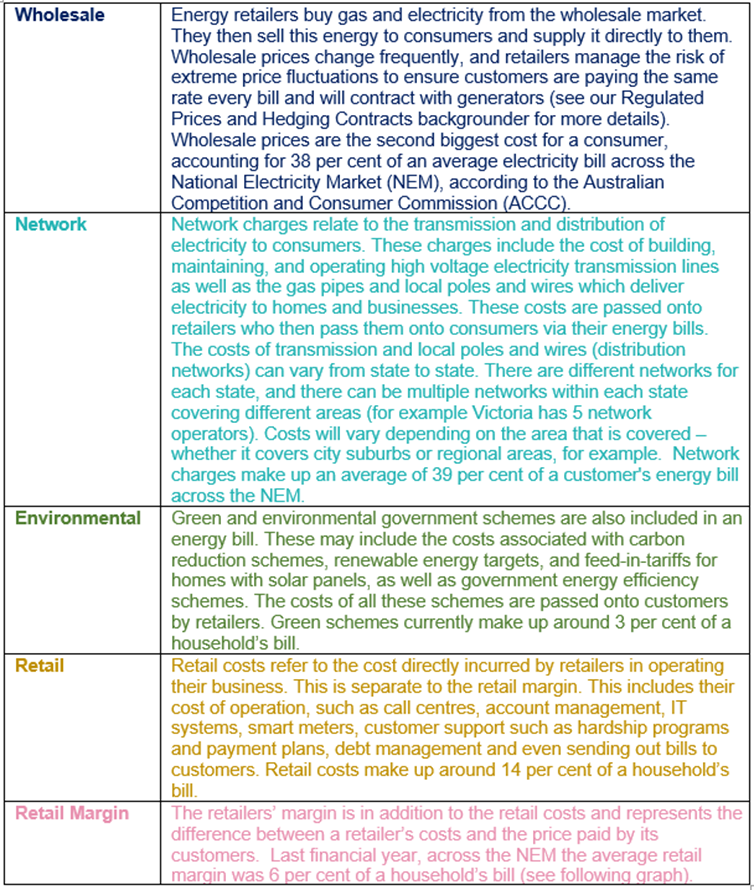
Figure 3: Average retail margins per residential customer across the NEM, 2007-09 to 2023-24
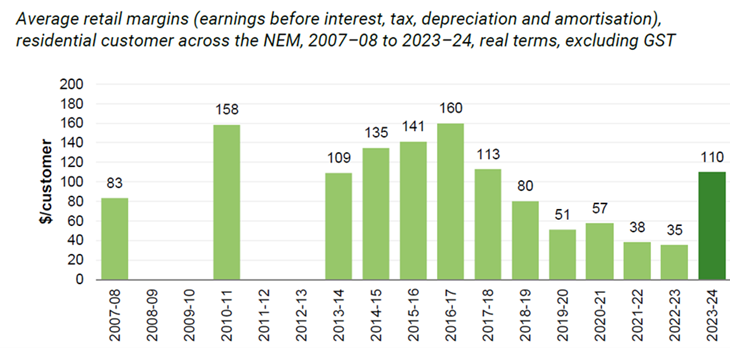
Source: ACCC, Inquiry into the National Electricity Market: December 2024 Report.
Regulated Prices
Regulators set an annual Default Market Offer (DMO) in NSW, SA and South-East Queensland) while Victoria has its own regulated price - the Victorian Default Offer (VDO). The DMO acts as a safety net and is set by the Australian Energy Regulator (AER). In Victoria, the Essential Services Commission (ESC) sets the VDO. Both come into effect on 1 July each year. The regulated tariff is based on the average amount of energy used by a consumer in that region. These default prices are set to protect customers who do not shop around for a market deal while letting retailers recover the costs of supplying electricity.
The price cap set by the DMO also acts as a benchmark known as the reference price. Energy retailers must use this when advertising their market offers to customers. Customers can use the reference price to compare different electricity plans when shopping around for a new offer.
The regulated prices are based on retailers' overall costs in delivering energy to customers. These default offers are not intended to be the lowest priced deals in the market.
Retailers do offer better priced market deals which are not set by the regulator, which is why it is recommended that customers shop around to find the best deal. It is important to not that every customer must display a fact sheet for every retail deal, which can be found on their website.
In May, the Australian Energy Regulator handed down its final determination for the 2025-26 DMO. For customers in New South Wales, Southeast Queensland and South Australia, the DMO (for residential customers without controlled load) will range from $1965 for Ausgrid customers, to $2741 for Essential Energy customers.[i] For households in Victoria, the annual VDO price will rise to $1675, which is a 1.2 per cent increase from the previous year. We have taken a look at the elements of the DMO in previous articles – Regulated prices: A look at network and wholesale costs; Electricity prices: Are retail Costs The Real Issue?
How to Compare Prices
For energy customers, finding a plan that matches their household’s usage profile can deliver noticeable savings. And while most in the sector are well aware of the regulatory frameworks and market dynamics that guide energy pricing, it’s worth revisiting how households can navigate the market, particularly as policy shifts and regulatory refinements continue to strengthen consumer protections and improve transparency.
Under current obligations, retailers must inform customers if they are on their best available offer or whether a cheaper plan is available. In Victoria, this “Best Offer” notification appears every three months on the front page of the bill. In other National Electricity Market jurisdictions, similar messaging is required at least once every 100 days. This approach ensures that customers are regularly reminded to assess whether their current deal continues to offer value.
Government-run comparison tools, such as Energy Made Easy and Victorian Energy Compare, provide accessible entry points for households wanting to evaluate their options. These platforms enable customers to input their energy usage data, ideally using details from a recent bill, and assess whether there is a better-suited or more competitively priced offer available.
While these tools are an effective starting point, the onus remains on customers to verify the details. Calling your existing retailer and asking directly about available tariffs or new market offers can often uncover better deals. It’s also worth confirming if your current retailer will match a competitor’s plan, as many will offer retention incentives. Before switching, customers should check whether any early exit fees apply and ensure that all relevant usage data is on hand to make an accurate comparison.
If a customer decides to move to a new offer or switch retailers, the process is generally straightforward. Retailers are required to provide a summary of the new plan, known as an energy price fact sheet, which outlines prices, terms, and conditions. This applies to all generally available market offers across Victoria, Queensland, New South Wales, South Australia, Tasmania, and the ACT. Customers can typically cancel a new plan within a ten-business-day cooling-off period, without incurring penalties. Flexible billing arrangements, including monthly billing, are also increasingly available and can assist with household budgeting.
Understanding Tariffs
The structure of a tariff, how a customer is charged for their electricity or gas, is a critical component of any plan. While the actual supply of energy remains unchanged regardless of the retailer, tariff design can significantly affect a household’s bill, depending on how and when they use energy.
Most electricity tariffs consist of two charges:
- A daily supply charge, which covers the cost of supplying energy to the property, regardless of usage.
- A usage charge, based on the amount of electricity consumed, typically shown as cents per kilowatt hour (c/kWh) for electricity or cents per megajoule (c/MJ) for gas.
There are three main types of electricity tariffs:
- Single rate tariffs (also known as flat, standard, anytime, or peak rate tariffs) apply the same rate regardless of when electricity is used. These are often a good fit for households that use most of their energy during peak periods (such as weekday evenings), as the rate can be lower than some time-of-use structures.
- Time of use tariffs vary the price of electricity depending on when it is used. Rates are typically highest during peak periods (usually weekday evenings), with lower prices during off-peak times (overnight and weekends) and intermediate “shoulder” periods. To access these tariffs, customers need a smart meter or interval meter capable of recording consumption in half-hourly blocks.
- Controlled load tariffs, sometimes referred to as dedicated circuit or off-peak tariffs, apply to specific appliances, such as electric hot water systems, that operate during low-demand periods. These appliances are metered separately and can access lower rates as a result.
Gas plans are generally simpler, using a block tariff structure. Customers are charged a single rate for a set volume of usage, after which the rate may increase. Seasonal pricing changes are also common, with higher rates applied during winter when demand spikes.
Support for Customers in Financial Stress
Retailers provide assistance to customers who are struggling to pay their bills. Early communication is key, engaging with the retailer as soon as possible can prevent disconnection and avoid additional fees. Support options may include payment extensions, tailored payment plans, or referral to formal hardship programs.
These hardship arrangements provide greater flexibility and, in many cases, can enable access to government concessions or rebates. For retailers, proactively identifying customers at risk of payment difficulty and providing a clear path to assistance is both a compliance obligation and a vital service to the community.
This article has a more detailed look at retail protections. More recently there have been reviews of consumer protections which are outlined here.
[i] This is for customers with an average annual energy consumption, ranging from 3,900kWh for Ausgrid customers to 4,900kWh for Endevour Energy customers.
Related Analysis
Network Tariff Reform: From Cost Recovery to Coordination in a High-CER System
Network tariff reform has shifted from a technical pricing issue to a central challenge for Australia’s future energy system, shaping affordability, market design and the transition to a customer-centric grid. Recent modelling by the Australian Energy Market Commission provides a timely and valuable contribution to this debate, with one of the most consequential ideas in its Pricing Review reform package being Recommendation 6—proposing that networks develop tariffs for retailers, rather than directly for end-use customers. We take a closer look at the implications.
Addressing Energy Affordability Needs More Than Short-Term Relief
The conflict in the Middle East has continued to highlight the challenges we face in ensuring energy supply remains accessible and affordable for everyone. Ensuring Australia becomes more resilient to international energy price shocks will dominate the energy policy landscape for some time, and rightfully so. But while political debate often gravitates toward regulatory interventions and subsidies that deliver short term household bill relief, the real solution lies in something far more complex: reshaping how the energy system works for consumers. What’s increasingly clear is that energy affordability is not just about price - it’s about design. That is why the AEC is releasing its Affordability Action Agenda today – an 8-point plan of critical actions that industry and governments need to take to ensure that energy remains accessible and affordable for all Australians. Read more.
Efficient Pricing in an Uncertain Energy Market
Electricity prices are once again front of mind for Australians, and with cost-of-living pressures mounting, expectations for fair and transparent pricing are entirely reasonable. But as reforms to the Victorian Default Offer and Default Market Offer evolve, a more complex challenge emerges: how to keep prices in check without undermining the stability, competition and investment needed to sustain the energy system over time. Striking that balance is at the heart of current reform debates, and will ultimately determine whether today’s affordability measures support or weaken the system in the long run. Read more.
Send an email with your question or comment, and include your name and a short message and we'll get back to you shortly.