




by Australian Energy Council
Renewables go from strength to strength
The latest Clean Energy Regulator Carbon Market Report provides further reinforcement of the rapid rate of deployment of renewable generation in the National Electricity Market (NEM).
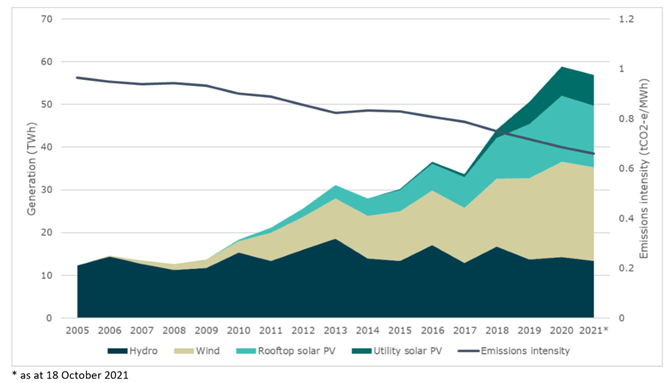
A record 32 per cent of electricity generated came from renewable sources in the third quarter while on 24 September the Australian Energy Market Operator (AEMO) reported instantaneous renewable generation of 61.4 per cent in the grid – the highest level recorded. The CER expects across the calendar year the contribution of renewable generation will be around 30 per cent, double the 15 per cent reported just four years ago. The increase in the contribution from renewable sources (capacity has grown by an average of 6GW each year between 2018 and 2020) has led to the emissions intensity of electricity supply in the NEM and SWIS falling from 0.79t CO2 in 2017 to 0.66t CO2 to end Q3 2021.
Figure 1: Annual renewable generation by type and emissions intensity 2005-2021
Source: CER
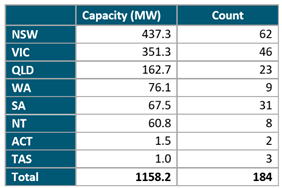
During the third quarter 603MW of new large-scale renewable energy capacity was approved taking the year’s total to date to 1.2GW, which while it is down on 2.7GW approved in the same period in 2020, this is partly because of the timing of accreditation for several power stations which were expected to come online early this year, but actually began generation in late 2020. Over the first nine months 184 power stations have been approved. There is expected to be 2GW accredited this year with more than 1.4GW under application in the last quarter.
Table 1: Power stations accredited
Source: CER
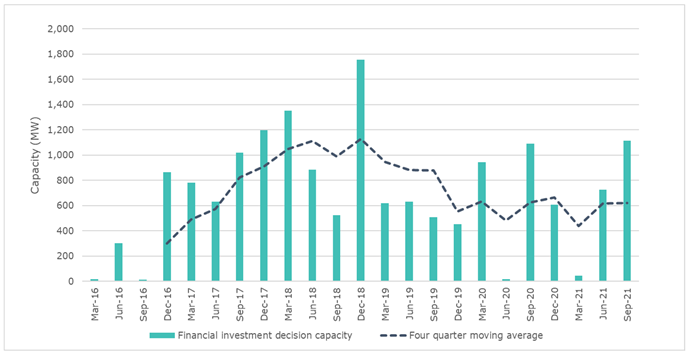
Investment is trending up for large-scale renewables with final investment decisions for 1.1GW in the third quarter and taking the total in 2021 to the end of September quarter to 1.9GW. This compares to only 44MW in the first quarter and 725MW in the second quarter.
A similar result to the Q3 outcome is expected by the CER in the final quarter and if achieved it would see FID capacity exceeding the 2.7GW reported in 2020.
Figure 2: Capacity committed per quarter and for quarter moving average (Q1 2016-Q3 2021)
Source: CER
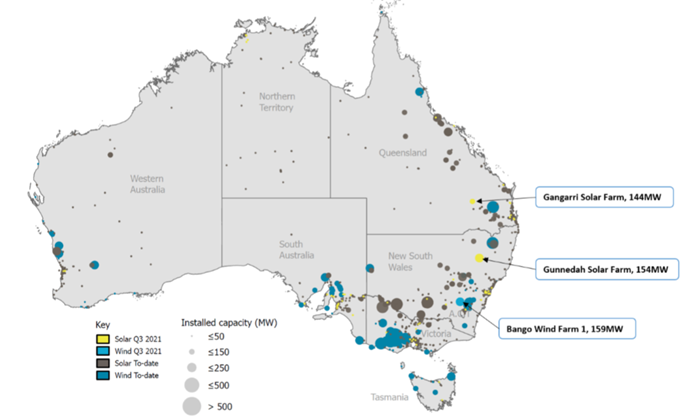
The siting of committed and probable renewable projects across Australia is shown in figure 3.
Figure 3: Committed and probable projects
Source: CER
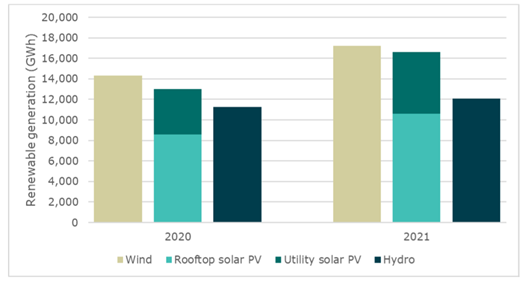
Wind farms were the main source of renewable generation in the quarter, but utility-scale solar had the biggest year-on-year growth – up 34 per cent from Q3 2020. The overall mix has stayed fairly stable with each of the large-scale sources contributing a similar proportion of generation between 2020 and 2021 (see figure below).
Figure 4: Renewable generation (NEM) over first three quarters 2020 and 2021
Source: CER
Wind generation accounted for 37 per cent of renewable generation and the CER believes that offshore wind represents significant potential to increase the scale of wind generation in Australia.
Large-scale certificate (LGC) spot prices increased significantly in the September quarter reaching $40.40, which is the highest price since January this year and according to the CER this matches the historical pattern as retailers secure supply ahead of the surrender date of 14 February 2022.
The CER expects LGC supply and demand to stay tight to at least 2023 as voluntary cancellation continues to increase and 17 million certificates are needed to claim $1 billion in shortfall charges from previous years.
Supply is expected to be at the top end of the regulators range forecast of 37-40 million. LGC supply in the third quarter was 9.2 million taking the total to the end of September to 26.4 per cent, a 22 per cent increase from the corresponding period in 2020. Further growth is expected in the Q4 which is typically the peak period and there could be increased LGC created from hydro generation based on the expectation of a wetter than average November to January period.
Not so small-scale
This year new large-scale generation capacity is expected to be beaten by the installation of 3.2GW of rooftop solar capacity, which would be a new record. The third quarter result for rooftop PV exceeded expectations with 755MW installed and the period also saw an increase in the average system size reported (8.42kW). While the installed capacity was the lowest quarterly result for this year it was achieved despite restrictions and limitations on installation work as a result of COVID-19 lockdowns in New South Wales, Victoria and the ACT.
Strong growth earlier in the year has meant installed capacity has increased by 2.3GW in the year to date, a 14 per cent increase over the same period last year and if the seasonal pattern for the last quarter follows that of previous years it would reach the forecast 3.2GW record for the full year. There is now a total capacity of 15.6GW of rooftop solar and with the increased capacity there has been record generation from rooftop solar.
Related Analysis
Wild Cards: Could these technologies advance the energy transition?
In December 2022, scientists at the National Ignition Facility achieved a landmark nuclear fusion result: a reaction that produced more energy than the laser pulse used to start it. It made headlines globally, but the caveats came quickly. Overall system energy use was still far higher, and commercial viability remains decades away. It was a real breakthrough, but also a reminder of how far the engineering still has to go. That gap between scientific progress and commercial reality is a defining feature of the energy transition today. While solar, wind, and batteries are scaling rapidly and doing most of the heavy lifting, the International Energy Agency estimates that nearly half of the emissions reductions needed for net zero will depend on technologies still at demonstration stage or earlier. This raises the key question: which “wild card” technologies could help close that gap?We take a look.
Australia’s Home Battery Surge: A Question of Equity
Australia is a global leader in rooftop solar, with more than 4.3 million households and small businesses installing photovoltaic (PV) systems as of February 2026. Battery uptake has also accelerated, particularly since the introduction of the Cheaper Home Batteries Program in July 2025, which offers around a 30 per cent upfront discount for systems between 5 kWh and 100 kWh. More than 236,000 batteries had been installed by February 2026, although this likely understates the true figure due to reporting lags; the Federal Government has since indicated installations have surpassed 250,000 as of March 2026. Despite this rapid growth, an important question remains: who is actually benefiting from these subsidies?
Integrated System Plan – What Should We Expect?
The release of an expert study of last year’s autumn wind drought in Australia by consultancy Global Power Energy[i] this week raised some questions about the approach used by the Australian Energy Market Operator’s in its 2024 Integrated System Plan (ISP). The ISP has been subject to debate before. For example, there has previously been criticism that some of the ISP’s modelling assumes what amounts to “perfect foresight” of wind and solar output and demand[ii], rather than a series of inputs and assumptions. The ISP is produced every two years and with the draft of the next ISP (2026) due for release soon, it is useful to consider what it is and what it is not, along with what the ISP seeks to do.
Send an email with your question or comment, and include your name and a short message and we'll get back to you shortly.