




by Jane Sing
Holding the line – price regulation during a cost-of-living crisis
Price regulation is a tricky function in any sector at any time but setting regulated annual prices in the complex system of electricity…this year – is a particular challenge.
Regulatory price setting involves a paradoxical circular process where the regulator observes what retailers’ costs are but in doing so signals to retailers what their costs ought to be. As a result regulated prices form a significant input to retailers’ revenue forecasts and impact their product design, pricing and wholesale portfolio risk management strategies – all of which are often set-up more than a year in advance. Therefore, it’s vitally important for market stability that regulators apply principle-based methodologies consistently across periods.
The Australian Energy Regulator (AER) and Victoria’s Essential Services Commission (ESC) both published draft default offers for the coming financial year (for their respective jurisdictions) on 15 March 2023. Being the first determination since last years’ wholesale market perfect storm, and in the face of a cost-of-living crisis, the usually bland topic of electricity price setting has gained increased media attention. In light of that focus it is useful to understand the different approaches employed and a detailed comparison is warranted.
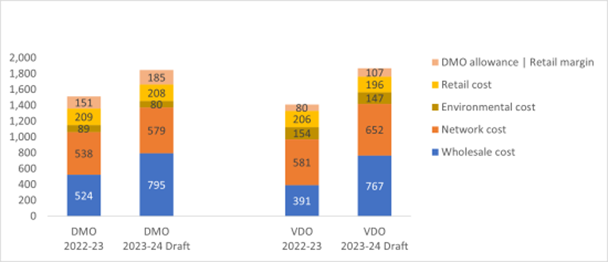
At a headline level, the AER’s draft DMO produced a circa 20 per cent increase (across both residential and small business tariffs) while the ESC’s overall draft Victorian Default Offer (VDO) resulted in a circa 30 per cent uplift. Figure 1 below presents year-on-year default offer price stakes for indicative tariff types and networks for each regulator.
Figure 1: Indicative year-on-year annualised price stakes. (DMO: Residential flat, Ausgrid, 3.9 MWh p.a. VDO: Residential flat, Powercor, 4 MWh p.a.)
Source: DMO price stake data: AER, Draft determination - Default market offer prices 2023–24 - Cost assessment model, VDO price stake data: ESC, 2023-24 Victorian Default Offer draft decision model
In both cases the wholesale energy cost (WEC) is the key contributor to the price rise. In absolute terms the increases are arguably closer but direct cross-jurisdictional comparisons are challenging due to diversity in annualised usage, weather, customers’ concurrent use of gas, and tariff types (such as control load tariffs).
What can be compared however is the regulators’ methodologies and consistency in approach (versus their propensity to influence the outcome). Here we unpack how each regulator has approached the biggest element - the flow-on of wholesale market impacts into customer pricing.
AER’s DMO
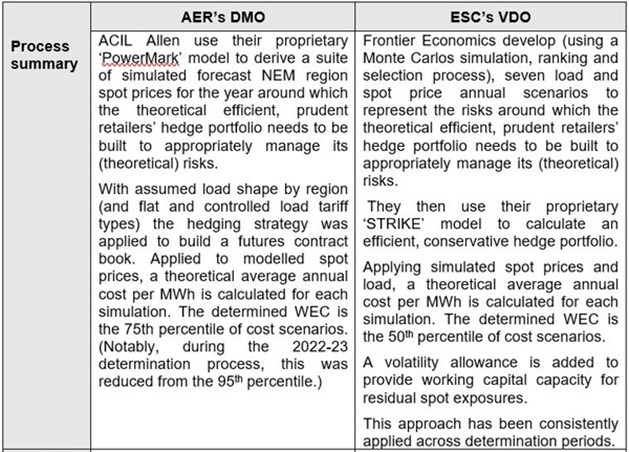
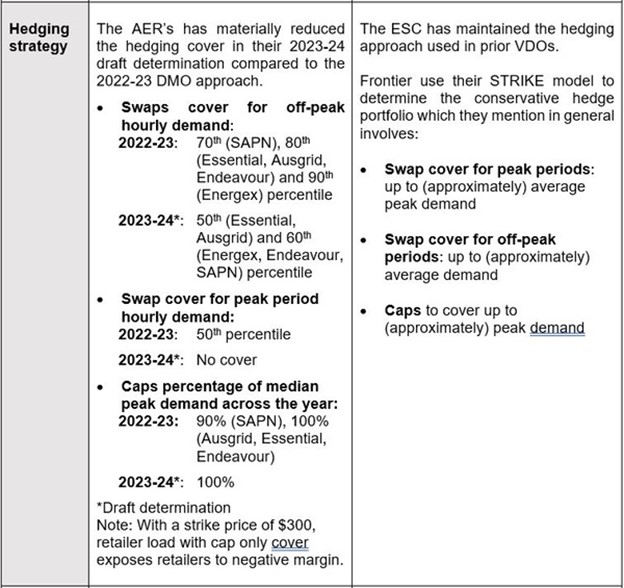
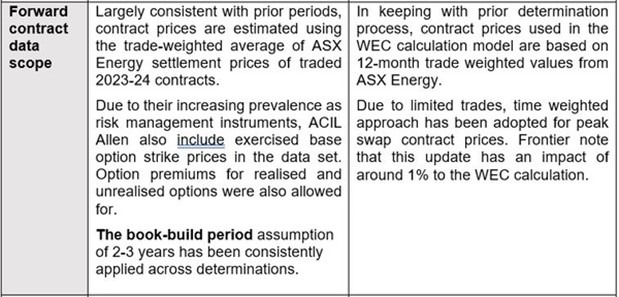
The overarching theme in the AER’s latest draft is their revision of the hedging strategy adopted. An inconsistent and less protective hedge approach to prior years, whereby off-peak demand has a lower level of swap cover, peak period swaps have been removed and there is more reliance on $300 caps. ACIL Allen (who were engaged by the AER to conduct WEC price modelling) provide some explanation for this change based on updates to load shape regarding carve out of demand during daylight hours, however it would be interesting to understand how much this strategy change has been brought about by ACIL Allen’s modelled spot price scenarios.
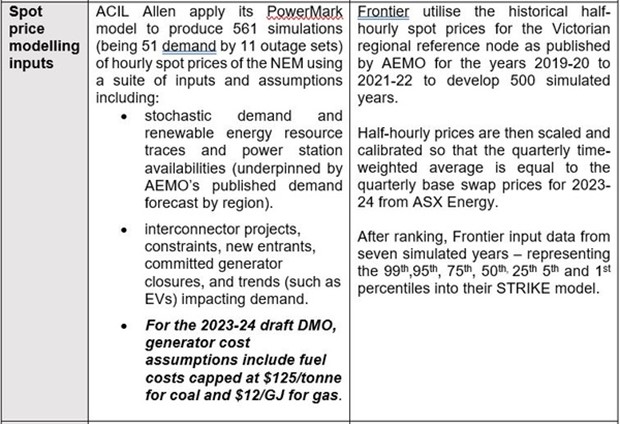
It's notable that in modelling spot scenarios for the 2023-24 year (to derive a suite of exposures a prudent retailer would hedge by procuring futures contracts over 2 to 3 years) ACIL Allen have applied the generator fuel price caps for coal (at $125/tonne) and gas (at $12/GJ). However, these are data points which retailers could not possibly have known for a large part of their book build period. Furthermore, this assumption excludes the higher priced fuel some generators likely purchased prior to the fuel cap implementation and assumes such caps are in place for the entire 2023-24 period (gas caps expire in December 2023). Given ACIL Allen use a proprietary modelling tool, the impact of these fuel cap inputs is difficult to ascertain, however it is logical to assume that the modelled spot price would have been higher and more volatile without them.
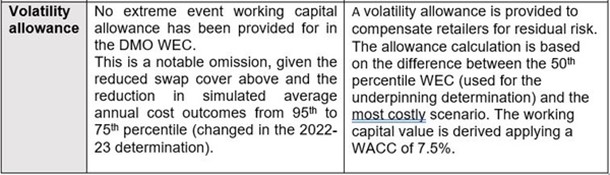
It's also notable that in reducing the swap cover, the AER have not provided a counter-balancing volatility working capital allowance. In the absence of such an allowance, it seems likely that the hedging structure adopted would be beyond the risk appetite of a prudent retailer and produces a WEC lower than reasonable expectations.
ESC’s VDO
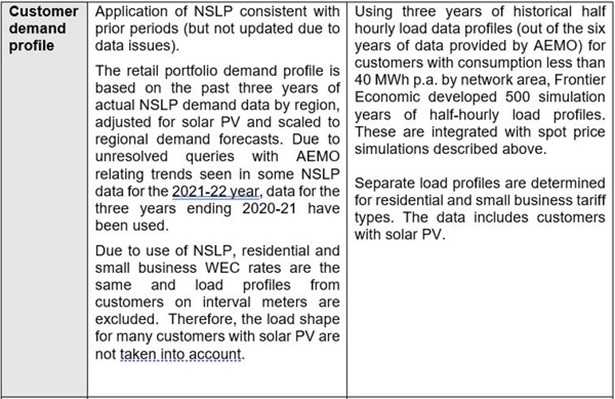
By contrast, the ESC, who engaged Frontier Economics to conduct the VDO WEC modelling, has applied consistency in their draft WEC determination for all key elements including the timeframes for data inputs used to capture observed ASX Energy prices (being 12 months), hedging strategy and inclusion of a volatility allowance to underpin financial viability in extreme price events.
A detailed comparison of the two approaches by element is provided in Table 1 below.
Table 1 - Comparison of WEC allowance methodologies and assumptions, AER’s DMO and ESC’s VDO – Draft 2023-24 determinations
Sources: DMO - ACIL Allen, Report to Australian Energy Regulator - Default Market Offer 2023-24, Wholesale energy and environment cost estimates for DMO 5 Draft Determination, VDO - Frontier Economics, Wholesale electricity costs for 2023-24, A draft report for the Essential Services Commission, 10 March 2023.
Evidently, the draft DMO’s WEC component represents a circa 50 per cent uplift[1] on the 2022-23 DMO, a lower increase than the draft VDO’s year-on-year 90 per cent uplift.
But with cost-of-living pressures, shouldn’t the government keep electricity prices down?
These are indeed large increases which, in the context of broader cost-of-living pressures, heighten some consumer expectations of regulators. There is a very important distinction between the role of the regulator, which is to set prices which are not unjustifiably high (reflecting costs for an efficient, prudent retailer in a competitive market), as opposed to the expectation sometimes espoused in the community - that the role of the regulator is to keep prices low.
For customers experiencing financial hardship, retailers play a supportive role - providing access to concession, hardship frameworks and tailored products. Beyond retailers, other actors in the system assist customers to cope with their costs of living including community welfare organisations and various levels of government. Importantly, this government support role is distinct to the role of the price regulator. In the coming financial year, the Energy Bill Relief Package seeks to perform this role by providing direct payments to vulnerable customers.
For a stable long-term and competitive system which ultimately benefits customers, regulators need to stick within their remit. And in doing so, consistency is essential.
What about the average cost of generation?
It has been suggested by the Victorian Energy Policy Centre that the ESC should “think again” and consider ratching (sic) the VDO down so that the WEC does not reflect the observed wholesale market rates but rather is “brought down to be in line with weighted average costs” of generation. Moreover, in public forums it’s been expressed that the ESC’s approach to the WEC in their draft decision affords retailers ‘headroom’ or ‘windfall profits’. Such comments dismiss the very important fact that the regulated price is a key basis for retailer revenue designed to cover their (retailer) costs in the supply-chain. Wholesale price regulation has recently ramped up via gas and coal price caps – which, assuming a consistent principled-based approach is maintained, will flow through to retail pricing (for default and market plans) overtime. Either way, the observed spot and contract market prices reflect retailer wholesale energy costs which need to be passed through to customers in a reasonable and consistent matter. Anything short of this risks significant under-recovery of retailer costs and one only needs to look at the UK market last year or the current state of Australia’s construction sector to understand the potential crisis which may ensue when such a cost-revenue mis-match prevails.
It is a testing time for regulators as they navigate the criss-crossed tracks of competing near-term priorities of varied stakeholder groups while keeping their eyes fixed on the longer-term view where all roads converge on the delivery of reliable, sustainable and affordable outcomes. Let’s hope they can muster the courage to stay the course.
[1] Due to variability across network regions, customer types and tariff types, increases range from 24% (Energex, residential, controlled load 2) to 66% (SAPN, small business, flat).
Related Analysis
Beyond the Rules: Lessons from the UK on Supporting Energy Consumers Experiencing Vulnerability
Customer vulnerability in the energy sector rarely follows a predictable path, often emerging through financial pressure, illness or sudden life disruption. The United Kingdom’s experience shows that early intervention, flexible support, trusted communication and coordinated care can significantly improve outcomes for households at risk. We explore what Australia can learn from the UK’s evolving approach to supporting customers experiencing vulnerability.
Network Tariff Reform: From Cost Recovery to Coordination in a High-CER System
Network tariff reform has shifted from a technical pricing issue to a central challenge for Australia’s future energy system, shaping affordability, market design and the transition to a customer-centric grid. Recent modelling by the Australian Energy Market Commission provides a timely and valuable contribution to this debate, with one of the most consequential ideas in its Pricing Review reform package being Recommendation 6—proposing that networks develop tariffs for retailers, rather than directly for end-use customers. We take a closer look at the implications.
Addressing Energy Affordability Needs More Than Short-Term Relief
The conflict in the Middle East has continued to highlight the challenges we face in ensuring energy supply remains accessible and affordable for everyone. Ensuring Australia becomes more resilient to international energy price shocks will dominate the energy policy landscape for some time, and rightfully so. But while political debate often gravitates toward regulatory interventions and subsidies that deliver short term household bill relief, the real solution lies in something far more complex: reshaping how the energy system works for consumers. What’s increasingly clear is that energy affordability is not just about price - it’s about design. That is why the AEC is releasing its Affordability Action Agenda today – an 8-point plan of critical actions that industry and governments need to take to ensure that energy remains accessible and affordable for all Australians. Read more.
Send an email with your question or comment, and include your name and a short message and we'll get back to you shortly.