



Global oil shock, but local calm - how the NEM is holding steady
Whilst Australia is lucky to be located well away from the horrors of the war in Iran, we are witnessing some economic impact with higher petrol and diesel prices. However, can there be impacts on the electricity market as well? In short, yes, but at this stage these impacts are minimal. In this article we will briefly look at how the oil price could impact the electricity market and what the market has observed so far.
Economic theory
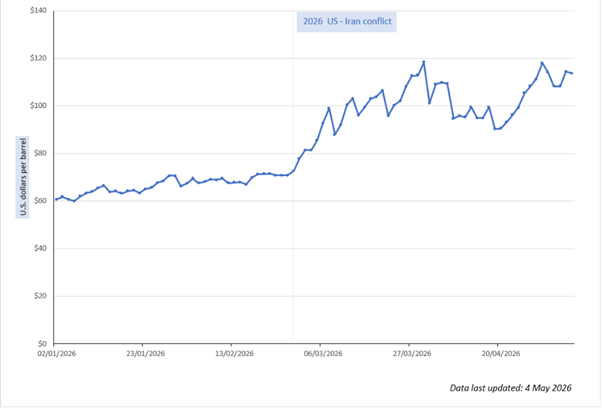
With the Strait of Hormuz closed, the world’s oil supply has decreased and the price increased, as shown in figure 1 below. This oil price rise flows through to international gas prices, which have a degree of oil priced linkage. In Asia, this increased cost of gas may lead to a switch from gas-fired power generation to coal-fired powered generation, which in turn may increase the international price for coal. In Australia this would be reflected in the Newcastle export price for coal. Coal contracts used to supply coal-fired generators in New South Wales and Queensland could increase over time, which will increase the cost of this generation.
Figure 1: Brent Oil Price
Source: Australian Energy Council’s analysis of Investing data
What has been observed so far?
At this stage, domestic wholesale electricity and gas prices have not appeared to change much.
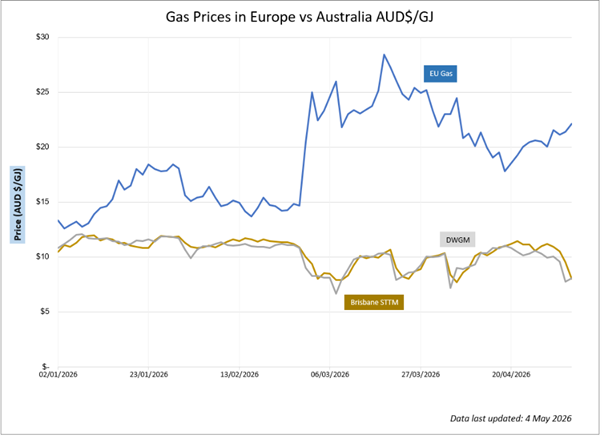
Firstly, domestic gas prices are hovering at relatively subdued levels this year. See, for example, the chart of gas prices below, which compares international and domestic prices. Whilst international gas prices increased significantly after the start of the conflict, domestic prices in Australia have actually decreased at times.
Figure 2: Gas prices
Source: Australian Energy Council’s analysis of Investing and NEO Express data
Domestic factors are currently prevailing, with record low gas-powered generation runs due to increased output from renewables and utility scale batteries. This is resulting in an oversupplied domestic gas market. Gas storages are also currently very healthy. While the domestic gas market is linked to international markets, this link is weaker at present because LNG export trains are largely already at capacity. Participants will continue to keep a close eye on domestic gas prices as we head into the cooler months of the year.
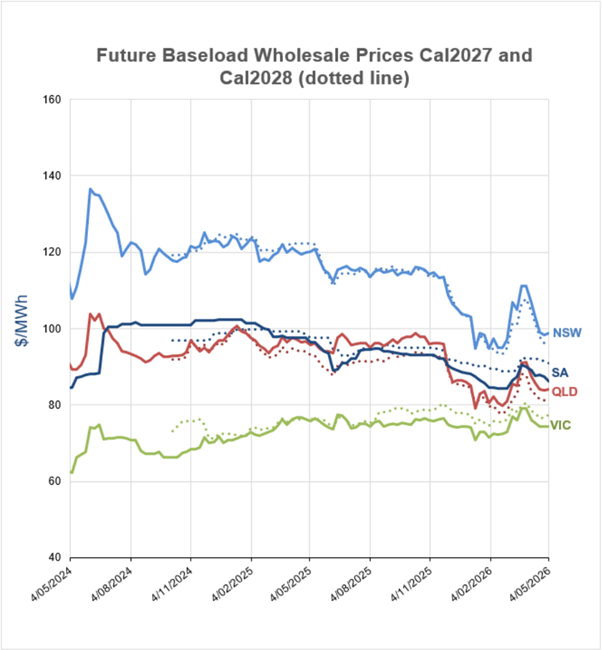
Wholesale electricity markets have so far reacted modestly too. For example, ASX NEM Baseload futures prices initially moved upwards in all states, but have since retreated. See the chart below of Cal27 and Cal28 baseload futures, with all NEM regions showing initial increases of about $10/MWh (more in NSW), before falling back to about pre-Iran war levels. These initial increases could be partly explained by participants covering positions now, to guard against future price rises (if the conflict was to continue for a long period).
Figure 3: Future Baseload Prices
Source: Australian Energy Council’s analysis of NEM Futures data (Global Roam)
The initial increase also likely reflects a risk premium driven by fear around potential international linkages to the domestic gas and coal markets. We may see increased demand for Australian coal, as the increase in Asian gas prices means coal generators in Asia are expected to run harder. However, the market has noted that Asian markets have responded with greater domestic coal production, which has helped.
So far, the export reference price for coal (Newcastle coal futures) has increased modestly over the past few months but is still within bounds of historically average levels. It is currently hovering around USD130/t.
Focus on diesel
Diesel fuel price and supply is being closely watched by energy market participants. Diesel is an important part of the electricity and gas supply chain as it is used for a variety of reasons such as re-starting coal units, fuel for vehicles at mine sites, for trains to transport coal and for maintenance vehicles at power stations.
If regulations are brought in to preserve the supply of fuels such as diesel, it will be crucial to prioritise uses that support the continuing and orderly function of the electricity system.
A less obvious supply chain issue that is also being watched by energy market participants is the availability of a range of products that rely on oil or gas-based inputs such as plastics and synthetic rubbers. These are inputs to various products required at power stations for basic maintenance.
Comparison to 2022
Whilst the war in Iran has only been going for about two months, comparisons are already being drawn to the 2022 energy crisis, which was preceded by Russia’s invasion of Ukraine.
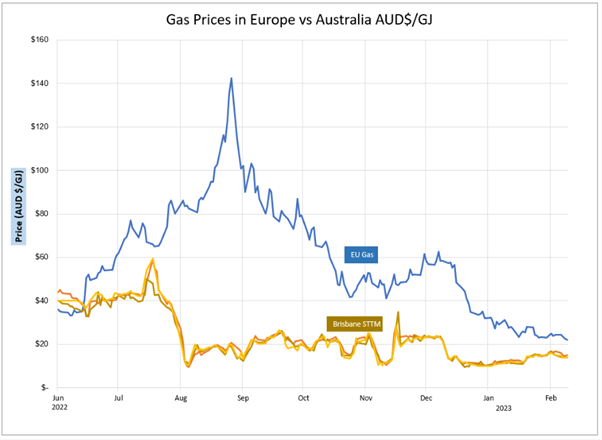
In 2022 there was a combination (an almost perfect storm) of an external shock coupled with local weather events, coal supply problems and power station outages. These domestic events are not currently occurring. The chart below shows the significant increases in domestic gas prices experienced in winter 2022.
Figure 4: Gas prices during 2022 Energy Crisis
Source: Australian Energy Council’s analysis of Investing and NEOExpress data
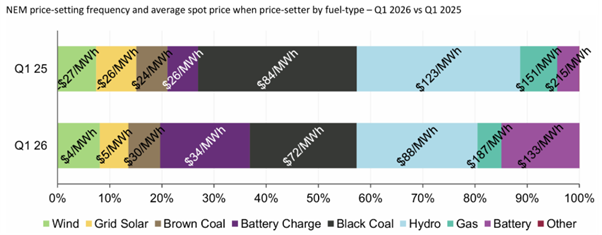
The domestic energy market has had some changes since 2022 that could be relevant. The electricity market now has a higher penetration of renewable generation, which currently makes up almost half of total generation in the National Electricity Market (NEM). There is also now a fleet of utility scale batteries to firm up renewable generation, which has lessened the demand for gas-powered generation, at least for periods of a few hours. The Australian Energy Market Operator (AEMO) has stated in its most recent Quarterly Energy Dynamics report that ‘increased price-setting by batteries reshaped market outcomes’.1 The following chart from AEMO shows how batteries are now setting the marginal price at more periods, at the expense of gas and other fuels.
Figure 5: Battery Price Setting .
Increased battery price setting reshaped market outcomes in Q1 2026
Source: AEMO Quarterly Energy Dynamics Q1 2026
In gas markets, a number of policy levers were introduced after the 2022 crisis and are still relevant. This includes the price cap and Conditional Ministerial Exemptions (CME) regime under the Gas Code which has provided contracts to the domestic market. Looking forward, the Government has announced a domestic gas reservation scheme to commence in 2027, the details of which are currently being consulted on.
Another comparative difference between 2022 and the current day is that we are expected to see warmer than average winter weather in the eastern states as well as a possible shift to El Niño by late winter, which typically brings hotter, drier conditions. In contrast, during winter 2022 there was colder-than-average weather in south-east Australia with cold snaps particularly in June, which helped drive energy demand.
Overall, the duration of the current Iranian conflict will be important. Most domestic energy market participants are comfortable with managing for a few months. However, if the conflict drags on, it increases the chances of other domestic events such as cold weather, wind droughts or generator outages also occurring at the same time. The market will need to stay vigilant and be prepared for further potential system shocks.
Related Analysis
Where’s the energy for new gas generation?
The importance of gas-powered generation (GPG) to our energy system is well recognised, with system planners and market operators often seeing it as an essential “last line of defence.” The role of gas generation has been further highlighted by two recent papers: the Australian Energy Council’s Energy2050 Vision for the Future Energy System and the policy paper “Are gas turbines ‘bankable’ in energy-only markets?” published by Griffith and Cambridge Universities. Despite this clear and ongoing need, investment in new gas-fired generation remains limited, raising important questions about market settings, policy signals and the future role of dispatchable capacity in a transitioning grid — we take a look.
Energy2050: Building the ‘Light on the Hill’ for Australia’s Net-Zero Future
Today, we are pleased to publish an important report for the Australian Energy Council and the energy industry. Energy2050 is intended to be a vision statement, providing a practical illustration of what it will take to deliver a net zero energy system while balancing affordability, reliability and sustainability. Read more.
Efficient Pricing in an Uncertain Energy Market
Electricity prices are once again front of mind for Australians, and with cost-of-living pressures mounting, expectations for fair and transparent pricing are entirely reasonable. But as reforms to the Victorian Default Offer and Default Market Offer evolve, a more complex challenge emerges: how to keep prices in check without undermining the stability, competition and investment needed to sustain the energy system over time. Striking that balance is at the heart of current reform debates, and will ultimately determine whether today’s affordability measures support or weaken the system in the long run. Read more.
Send an email with your question or comment, and include your name and a short message and we'll get back to you shortly.