




by Australian Energy Council
Explainer: Regulated prices and hedging contracts
With the release of the latest draft determinations for the regulated retail prices – the Default Market Officer (DMO) and Victorian Default Offer (VDO) - we have put together this explainer on how they are set, and how they came about. We also consider retailers’ approaches to contracting, which is considered as part of the default setting process.
Each financial year, Government regulators (the Australian Energy Regulator and the Essential Services Commission in Victoria) set regulated prices – the Default Market Offer in New South Wales, South Australia and South-East Queensland, and a separate Victorian Default Offer (VDO). These take effect on 1 July each year.
The default offers act as a safety net for those customers (around 10% of residential customers in the NEM) who do not shop around for competitive market deals from retailers. They are intended to protect customers from high standing offer prices but also to allow retailers to recover their costs of supplying electricity.
The regulated prices are based on retailers' overall costs in delivering energy to customers. These default offers are not intended to be the lowest priced deals in the market, but to be a reference price for customers.
The DMO was introduced following a recommendation by the Australian Competition and Consumer Commission (ACCC). It was one of the reforms identified in the ACCC’s Retail Electricity Pricing Inquiry final report released in July 2018. The VDO was introduced following the Thwaites Review released in August 2017. The DMO and VDO have been in place since July 2019.
To set the regulated price the regulators consider the retailers overall costs to deliver energy to customers. For example, the DMO takes into account:
- Wholesale prices – the cost retailers pay to generators for electricity, including contracting.
- Network costs – the cost of local poles, wires and high voltage transmission lines to transport the electricity to homes and businesses.
- Environmental costs – the cost of complying with government green schemes that are passed on to energy users.
- Retailer costs. There is a retail allowance and margin – this is for IT systems, call centres, customer support schemes, like hardship programs, debt management, smart meters and billing. The retail allowance reflects the efficient cost of operating in a region, including a reasonable margin as well as customer acquisition and retention costs. Retail margins – to ensure room for competition, the regulator will consider a reasonable profit for retailers.
Around 80% of a customer’s power bill is made up of the costs of generating electricity (wholesale), and the costs of the poles and wires (networks), which retailers pass on to the customer. After the costs of green schemes are factored in, around 12% of the bill is made up by the retail component. (see ACCC graph below for breakdown of cost stack).
DMO objectives are to protect customers from “unjustifiably high prices, while enabling retailers to recover their costs and also maintain incentives for retail market competition, participation and innovation”. It’s important for retailers to be able to cover their costs given they carry the risk of the supply chain. Since May 2022, 11 retailers have left the market due to the pressure from higher wholesale prices - the last retailer to leave the market prior to 2022 was in 2019, and the ACCC reports there was only 1 a year between 2016 and 2019.
In determining reasonable costs for a retailer, the AER uses a 2-3 year hedge book build period. This reflects the fact that retailers enter hedge contracts (see below) with generators to manage their customer needs and smooth price variations (volatility) in the wholesale market (these can range from negative $1000 to a maximum of $16,600). Contracts will roll off over time, with new contracts replacing previous agreements.
The DMO assumes a retailer will purchase hedges over a 3-year period. Therefore, the expiration of these contracts can be a factor in determining when and how the wholesale cost component of their electricity charges will change.
Retailer Contracting
A key function of the retailer is managing the wholesale market risk on behalf of their customers. Retailers offer customers competitive market tariffs which are not set by the regulator and will usually offer cheaper prices than the default offers. To be able to offer customers stable retail prices, which will typically change once a year, retailers will contract with generators to supply electricity at a fixed price over the course of a year, or several years. These are known as hedge contracts.
Without fixed contracts, retailers would have to buy off the spot market which can and does fluctuate constantly – spot prices can go as low as minus $1000/MWh and as high as $16.600/MWh (this maximum price is CPI indexed and will go to $17,500/MWh from 1 July 2024). The exposure to such highs and lows is a significant financial risk to retailers and contracts reduce that by locking in a price for a specific period.
It means retailers can offer customers a stable price, usually for a 12-month period.
An unhedged retailer can face huge losses if prices spike at times of high demand or low supply. In supplying homes and businesses with electricity at an agreed price, retailers have to meet that price regardless of if the spot market price rises or falls.
According to the Productivity Commission[i], retailers have followed several different strategies, ranging from attempting to fully hedge their position to holding a minimal hedging position and this will often reflect their risk management strategies.
There are a number of derivatives or financial contracts that can be used to hedge but the main contracts are swaps and caps.
A swap involves both parties entering into a hedging contract which sets the price they will pay for electricity in advance.
Under this arrangement, the generator makes a payment to the retailer if the price is high, and the retailer makes a payment to the generator if the price is low. All electricity must be sold through the NEM control pool, however, the two parties settle in cash once the electricity purchase has taken place.
A cap is a hedging contract that gives the holder the option to buy a given amount of electricity at an agreed price. A peaking cap is similar to a flat cap but can only be called on during peak hours.
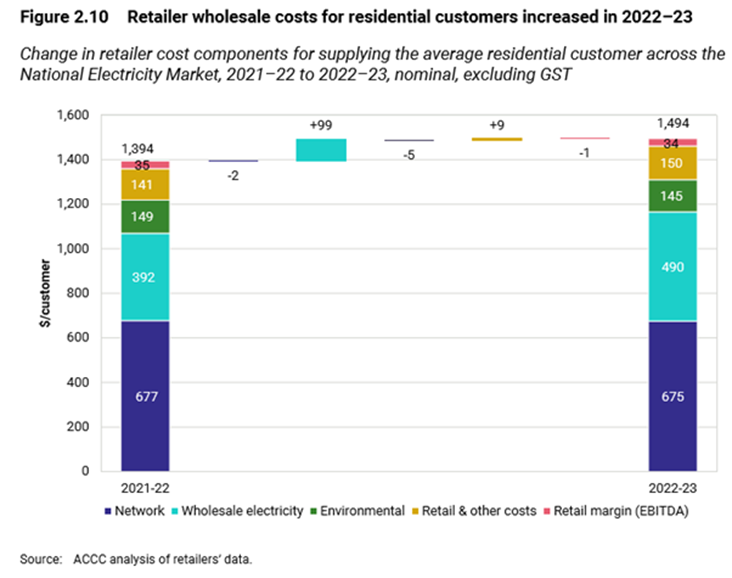
[i] https://www.pc.gov.au/inquiries/completed/electricity/report/28-electricity-appendixc.pdf
Related Analysis
Network Tariff Reform: From Cost Recovery to Coordination in a High-CER System
Network tariff reform has shifted from a technical pricing issue to a central challenge for Australia’s future energy system, shaping affordability, market design and the transition to a customer-centric grid. Recent modelling by the Australian Energy Market Commission provides a timely and valuable contribution to this debate, with one of the most consequential ideas in its Pricing Review reform package being Recommendation 6—proposing that networks develop tariffs for retailers, rather than directly for end-use customers. We take a closer look at the implications.
Addressing Energy Affordability Needs More Than Short-Term Relief
The conflict in the Middle East has continued to highlight the challenges we face in ensuring energy supply remains accessible and affordable for everyone. Ensuring Australia becomes more resilient to international energy price shocks will dominate the energy policy landscape for some time, and rightfully so. But while political debate often gravitates toward regulatory interventions and subsidies that deliver short term household bill relief, the real solution lies in something far more complex: reshaping how the energy system works for consumers. What’s increasingly clear is that energy affordability is not just about price - it’s about design. That is why the AEC is releasing its Affordability Action Agenda today – an 8-point plan of critical actions that industry and governments need to take to ensure that energy remains accessible and affordable for all Australians. Read more.
Efficient Pricing in an Uncertain Energy Market
Electricity prices are once again front of mind for Australians, and with cost-of-living pressures mounting, expectations for fair and transparent pricing are entirely reasonable. But as reforms to the Victorian Default Offer and Default Market Offer evolve, a more complex challenge emerges: how to keep prices in check without undermining the stability, competition and investment needed to sustain the energy system over time. Striking that balance is at the heart of current reform debates, and will ultimately determine whether today’s affordability measures support or weaken the system in the long run. Read more.
Send an email with your question or comment, and include your name and a short message and we'll get back to you shortly.