




by Carl Kitchen
Reviewing the Reviews, Part II
2024’s first meeting of the Energy and Climate Change Ministerial Council (ECMC) last week again brought to the fore the extent of change underway in the energy sector.
The communique from the ECMC meeting hints at the breadth of reviews and assessments of the energy sector and operations of the National Electricity Market (NEM).
It's part of a now long-established pattern. For well over a decade, energy has been at the forefront of policy developments, largely because of the significant changes to our grid. Along with those changes has come a heightened political involvement given the potential impacts on reliability and affordability. With political interest has come a myriad of reviews, assessments and interventions to make the NEM “fit for purpose”. Many changes require further reviews and adjustments.
With cost-of-living concerns and reliability to the fore, the current period is akin to the atmosphere surrounding energy in 2017. Like now, there was increased political concern around the cost of energy, as well as grid stability and reliability in the face of the introduction of renewable generation (and on the back of major events like the South Australian system black in 2016). At that time there were at least 27 major reviews and assessments underway, and a range of market changes in train, which we considered in Reviewing the Reviews.
Below we take a look at the ECMC Communique, as well as some of the reviews currently underway into the energy market.
Reviewed, Monitored and Regulated
Energy remains the most reviewed, monitored and regulated sector in Australia. The NEM - its wholesale and retail elements and the network regulatory framework - have all been subject to ongoing monitoring since its creation. Some of the analysis being undertaken and listed below, is part of the regular assessment of aspects of the market and its operations, although even this element has been expanded over recent years. In addition, there are rule change proposals that come under assessment and are not covered in this paper.
The number of reviews and initiatives underway may suggest governments of all persuasions continue to struggle with some of the problems being thrown up by the energy transition. The proposal for an orderly exit management framework (OEMF), for example, as proposed by the NSW Government, is an attempt to tackle the loss of dispatchable plant. Yet as we noted in our submission, this proposal is on top of existing mechanisms to manage coal plant closures, that it should act only as a last resort measure and that due regard is given to existing regulatory arrangements supporting an orderly transition. This includes the Retailer Reliability Obligation, notice of closure requirements, and proposed energy transition rule change that would give the Australian Energy Market Operator (AEMO) the power to contract services. As the AEC noted in its submission on the framework under the "improving security frameworks for the energy transition" rule change, the Australian Energy Market Commission (AEMC) is proposing to grant AEMO broad powers to contract for services during the transition which may include contracts to extend the life of thermal generators. It is a proposal which has very broad support from industry and seems likely to proceed.
The extent of reviews into elements of the energy sector as well as the scale of some of the changes proposed also suggest that not only market bodies, but also government departments and market participants, will all continue to be challenged to manage and provide input into the myriad of assessments.
The Communique
A quick look at the latest communique from the ECMC indicates the range of reforms and changes underway or planned.
One of the most significant reviews is the Future Market Design of the National Electricity Market. This follows the previous ESB Post-2025 review (2021) and Finkel Review (2017).
The latest review is expected to be initiated and terms of reference released no later than next month. Ministers committed to finalising the response to the review, including the final design of any capacity mechanism, by the end of 2025.
Energy ministers have also committed to supporting Consumer Energy Resources (CERs) and undertaking reforms through a National Consumer Energy Resources Roadmap to deliver “new consumer protections, network reforms that will allow consumers to export more solar power to the grid, and nationally consistent standards in key areas, including to enable vehicle to grid technologies”. There is a dedicated taskforce that will be supported by a stakeholder reference group. Prior to the ECMC, a final report by the former Energy Security Board (ESB) was released – Consumer energy resources and the transformation of the NEM – which recommended government convene a CER taskforce with a focus on driving six priorities over 12 months.
Major changes currently underway include the expanded Capacity Investment Scheme (CIS) and renewable energy transformation agreements (RETAs). The RETAs are intended to be bilateral Agreements between the Federal government and state and territory governments. The RETAs are expected to account for more than half the capacity offered under the CIS (18 of 32GW).
The Australian Energy Infrastructure Commissioner’s Community Engagement Review report, which was released last month, did flag a range of issues and the Federal Government will now “work closely with state and territory governments, industry and councils to respond to the recommendations as part of a “broader community engagement strategy”.
A priority will be considering options for the design of a national developer ratings scheme with an expectation it will draw on input from a reference group made up of industry, peak bodies, consumer groups and other stakeholders.
A Federal net zero plan that will include six net zero sectoral plans. The electricity and energy sector plan is expected to outline pathways for further emission reductions “while ensuring affordability and reliability” and to build on existing initiatives including “the National Energy Transformation Partnership, Rewiring the Nation, and the Capacity Investment Scheme”.
Energy Ministers have also asked senior government officials to work with the Australian Competition and Consumer Commission (ACCC), the Australian Energy Regulator (AER) and Energy Consumers Australia (ECA) to develop a “consumer-focused reform package” for agreement at the next ECMC.
A non-exhaustive list of recent Reviews
Whole of system reviews:
- 2024-25: Future Market Design of the National Electricity Market
- August 2021: ESB Post 2025 Market Design Review
- July 2018: ACCC Retail Electricity Pricing Inquiry
- June 2017: Independent Review into the Future Security of the NEM (‘Finkel Review’) – “Blueprint for the future”.
Recent major AEMC reviews:
- February 2024: Review into the arrangements for failed retailers’ electricity and gas contracts (‘ROLR Review’)
- February 2024: Review of the Retailer Reliability Obligation (‘RRO Review’)
- November 2023: Review into electricity compensation frameworks
- November 2023: Review of the form of the reliability standard
Since 2005, the AEMC has undertaken 179 market reviews which can be found here: https://www.aemc.gov.au/our-work/market-reviews-and-advice.
Recent AEMO reviews:
- November 2023: 2024 General Power System Risk Review
- December 2023: Draft 2024 Integrated System Plan
- December 2023: Review of technical requirements for NEM connection
AEMO has legislative responsibilities to regularly undertake reviews related to system security and market operation (such as the General Power System Risk Review and Review of Technical Requirements for NEM Connection), as well as its biannual comprehensive NEM Roadmap, known as the Integrated System Plan.
Summary of recent, key AER Reviews:
- Value of customer reliability
- Market liquidity obligation exchange review
- Annual Default Market Offer review
- Review of the cost benefit analysis and regulatory investment test guidelines
- Review of incentive schemes for regulated networks
- Review of consumer protections for future energy services
The full list is here: https://www.aer.gov.au/industry/registers/resources
Essential Services Commission of Victoria:
- February 2024: Annual minimum feed-in tariff review
- March 2024: Annual VDO review
Other state-based reviews include:
- NSW Independent Pricing and Regulatory Tribunal (IPART, Dec 2023) – Monitoring the retail energy markets 2022-23 (annual)
- Queensland Competition Authority (Dec 2023) – Regulated electricity prices for regional QLD 2024-25 (annual)
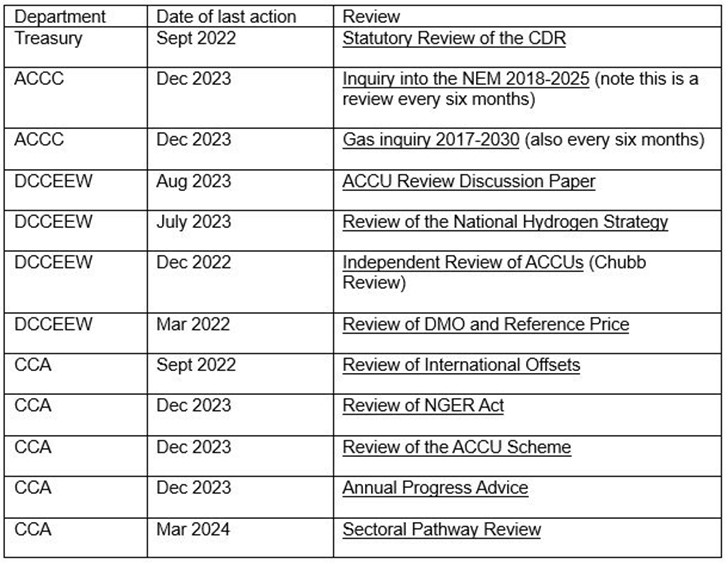
Some Govt. department/agency reviews since 2022 include:
Related Analysis
Getting it right: How to make the “Solar Sharer” work for everyone
On paper, the government’s proposed "Solar Sharer Offer" (SSO) sounds like the kind of policy win that everyone should cheer for. The pitch is delightful: Australia has too much solar power in the middle of the day; the grid is literally overflowing with sunshine: let’s give households free energy during 11am and 2pm. But as the economist Milton Friedman famously warned, "There is no such thing as a free lunch." Here is a no-nonsense guide to making the SSO work.
Energy Affordability: Will Solar Sharer reduce energy costs?
Energy affordability has been a hot topic for the last few months. Whilst the first term of the Albanese Government could be characterised as being focused on shifting the narrative on renewables development, it seems likely that its second term will need to consider how to deal with affordability, for both households and businesses. So what is the likely direction of travel for energy prices in the medium term, and is there anything industry and consumers can do to minimise the impacts? And can measures like the announced Solar Sharer help?
Exploring consumer duty in energy: Opportunity, challenge, and pathways forward
Across regulated sectors, a new idea is gaining traction: a consumer duty requiring businesses to act in the best interests of their customers. In financial services, it has already reshaped how products are designed, marketed, and supported. While energy retailers don’t yet operate under such a framework, its potential adoption raises important questions about the role of retailers, the nature of regulation, and how to deliver better consumer outcomes. This article explores how such a framework might operate in the energy sector, its opportunities and risks, and the conditions needed for it to deliver real benefits, while offering ideas to inform the Australian Energy Council’s developing position.
Send an email with your question or comment, and include your name and a short message and we'll get back to you shortly.