



Joint AEC-CEC rule change to enhance system security frameworks
The National Electricity Market (NEM) is undergoing a period of rapid transformation as governments and industry work to deliver reliable, secure, and decarbonised electricity. Recently, there has been a focus on delivering services critical to maintaining system security as the NEM transitions to a power system with more renewable energy resources. This has been highlighted by the Australian Energy Market Operator’s latest Transition Plan for System Security (TPSS), and the further delay to the closure of the Eraring Power Station.
Energy security - a critical and current issue
While the concept of energy reliability is reasonably well understood, system security involves much more technical and ‘nerdy’ power engineering concepts. In AEMO’s words “whilst energy reliability requires sufficient generation and network capacity to meet customer demand, the requirements for system security are more technical, and include system strength, frequency and inertia, voltage control, transient and oscillatory stability, operability, and system restoration.”[i]
Such energy security services have historically been provided by thermal plant. However, as large coal-fired generators retire, transmission companies have been investing in replacement technologies such as synchronous condensers. We think there will also be a role for other technologies to play in the future, such as grid-forming inverters, gas-fired generators with clutches and large inverter-based loads.
Joint AEC-CEC rule change proposal
On 21 January 2026, the Australian Energy Council (AEC) and Clean Energy Council (CEC) lodged a joint rule change request with the AEMC titled Enhancing system security frameworks[ii] (‘rule change request’). This rule change request has broad stakeholder support across the membership of the two organisations, including from thermal, hydro, batteries and other inverter-based resources. It is also intended to be complementary and additional to the related rule change proposal lodged by AEMO in November 2025, referred to as Efficient and timely management of system security needs through the energy transition[iii].
The AEC and CEC support the intent of AEMO’s rule change request and many of the proposals contained in it. However, the industry views solving these issues as crucial to enabling a successful energy transition and has put forward our rule change in the hope the scope of possible solutions can be broadened.
The rule change request considered the existing rules and identified some gaps that have created issues in the process, transparency and accountability of the essential system services (ESS) frameworks. Improvements to the existing transitional frameworks are not only crucial to facilitate an orderly energy transition but also to lay down the foundation for an enduring and efficient market in the longer term.
In summary, five main themes have been identified:
- No single body is ultimately responsible for successful deployment of ESS
- Forward planning signals do not provide sufficient lead time for investment in ESS
- There is a lack of clear and consistent investment targets or service requirements for procuring ESS
- There is no well-defined procurement process for ESS
- There is no clearly defined market-wide ESS technical specifications.
The TPSS highlights the importance of energy security for the transition
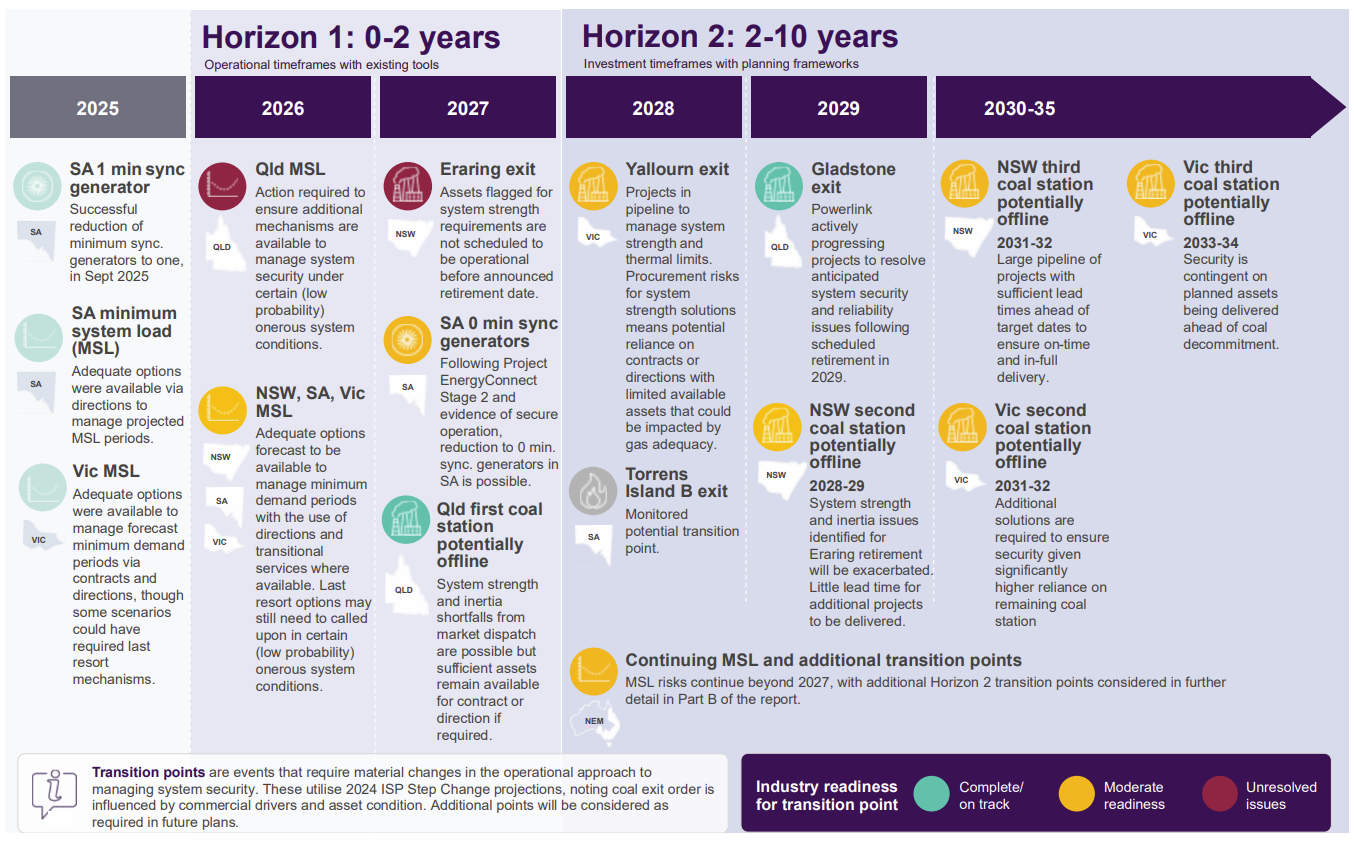
The most recent TPSS, which was released in December 2025, provides a helpful snapshot of how crucial ESS issues have become. It highlights expected system security needs for each region of the NEM over the coming decade. Some examples of the issues identified include[iv]:
- Queensland – potential system security issues from 2026-27 relating to certain (low probability) minimum system load events.
- New South Wales - System strength deficits from 2027-28 with the then expected [v] Eraring Power Station retirement date of 2027.
- Victoria - emerging system strength needs are anticipated from 2028-29, primarily associated with the planned closure of Yallourn Power Station.
Figure 1 taken from the TPSS provide a helpful overview of the issues AEMO has identified across the relevant time horizons.
Figure 1: Summary of NEM transition points (Click here to see enlarged version)
The importance of the issues in New South Wales was made apparent when on 20 January this year, Origin Energy announced[vi] a further delay to the closure of the Eraring Power Station:
“Origin Energy Limited (Origin) has advised the Australian Energy Market Operator (AEMO) that it will extend the operation of all four units of the Eraring Power Station from 19 August 2027 to 30 April 2029, to support energy supply in NSW through the energy transition.
Extending Eraring’s operation reduces risks to system security highlighted by AEMO in its recently released Transition Plan for System Security and enables the plant to continue to support reliable power to NSW households and businesses.”
The Eraring plant was originally announced to retire in 2025, but has since been delayed to 2027 and now to 2029. Whilst the general public may be aware of a potential lack of replacement capacity, most would not have understood that more technical system security problems are now also playing a role in these delays.
On 29 January 2026, AEMO released its Quarterly Energy Dynamics report for Q4 2025. Regarding energy security it stated that[vii]:
“System security directions to manage system strength and minimum system load increased, and network limits impacted economic offloading of VRE…
Interventions in the market, via directions to market participants, were required to maintain system strength as the number of synchronous generators online at times dipped below required levels in New South Wales and Victoria. Directions were also issued to manage minimum system load conditions in South Australia on multiple low demand days in November and December.”
In response to some of these problems, the AEC-CEC rule change request has proposed three main improvements to:
1. Planning obligations
2. ESS governance
3. Procurement processes
Planning obligations
We propose to amend the National Electricity Rules (NER) to provide greater guidance on the required information in the TPSS and to elevate the strategic importance of the TPSS in broader system planning. This would involve a set of principles in the NER that would be actioned through guidelines/procedures to be developed by another body (nominally the Reliability Panel, aligned with their current obligations to review the TPSS).
We propose the TPSS be expanded to include specific actionable plans. We believe these should be considered a foundational starting point and be included as NER obligations:
- As traditional providers of ESS retire from the market, AEMO should identify new ways of how ESS may be provided (by one or multiple service providers jointly); and
- Provide a fully operational, dispatchable, and investable plan for operating the grid with limited to no synchronous units online or when such units are unavailable due to a combination of planned maintenance and unplanned outages.
We note that the 2024 and 2025 TPSS Reports are very different, with the 2025 version including a lot more of what we believe is required. We propose the key elements of the TPSS should be defined in the NER to support investment certainty. This will enable the market to play its key role in supporting the provision of ESS as the energy transition continues.
ESS Governance
We propose the NER be amended to specify who is responsible for determining the efficient level of ESS to be procured, and the factors that should be considered. This would include but not be limited to determining what scenarios[viii] the market should prepare for through forward investment versus operational management, the level of risk to be maintained, how lead times for investment should be considered, and the backstop mechanism to address critical and/or unforeseen credible gaps.
Currently cost-benefit decisions are implicitly managed through the T-3 setting by AEMO. We propose the AEMC consider whether procurement targets should be set by an industry/consumer panel similar to how market settings are reviewed by the Reliability Panel.
Procurement processes
We propose to amend the NER to provide greater clarity over roles and responsibilities for ESS procurement. This includes:
- Creating more jurisdictionally consistent ESS specifications[ix] - how AEMO determines the specifications for each of the essential system services being procured.
- Determining the technology mix - how the TNSP determines the appropriate and lowest-cost technology mix following the need being identified by AEMO.
- Procurement approach - how the TNSP procures the relevant ESS once a technology mix is determined. This would include:
-
- Who should run the procurement and how assessment decisions are made/approved.
- Whether procurement should be on a tender basis (e.g. annual ESS tenders) or on a bilateral basis.
- The nature, tenor and standardised terms/conditions of the contract that is entered into for a non-network ESS solution.
- Biennial review of the procurement process to ensure it remains fit for purpose and can adapt and evolve with the changing needs of the market.
The NER should require the creation of national technical definitions and specifications for ESS as these services are identified and developed.
Next steps
Australia is well progressed in its transition to a cleaner energy system and this is something the nation should be proud of. In the last quarter of 2025, the NEM achieved just over 50% renewable energy for the period, with a peak renewables contribution of 78%[x].
However, there is still more hard work to do. The AEC-CEC joint rule change request seeks to improve the provision of system security and remove one of the potential roadblocks to planned thermal unit retirements. We understand the AEMC is currently considering this rule change request and AEMO’s, and may combine the two with a consultation paper likely in mid-March 2026. We look forward to further constructive discussion across the industry on this critical issue and encourage interested stakeholders to participate in the AEMC rule change process.
[i] 2025 Transition Plan for System Security, AEMO, December 2025, p 4.
[ii] Clarity and transparency in security frameworks | AEMC
[iii] Security framework enhancements | AEMC
[iv] 2025 Transition Plan for System Security, AEMO, December 2025, see p 8-9.
[v] As of December 2025; note the Eraring closure has since been delayed.
[vi] Origin Extends Eraring Power Station Operations To 2029 - Origin Energy
[vii] Quarterly Energy Dynamics Q4 2025, AEMO, January 2026. See p 4.
[viii] Examples include delays to synchronous condensers, weather events, seasonal operation of synchronous plants and changes in uptake of inverter-based resources (IBR).
[ix] For example, this could involve TNSPs aligning on how they determine that system strength requirements are met. Specifications could also be prescribed for the service itself, which are the basis for the procurement process.
[x] Quarterly Energy Dynamics Q4 2025, AEMO, January 2026. Note that the 50% figure quoted includes renewables and storage.
Related Analysis
Clarity and understanding key ingredients for successful transition
The energy system is complex and decarbonising the grid adds further complexity. It requires significant new investment to ensure coal plants can exit without having an impact on the reliability of the grid. It comes with unavoidable costs and will take time to get right. It is increasingly important given this context that the energy transition is well understood. Selective framing of data to apportion blame works against a broad understanding and has the potential to undermine customer confidence and support for the transition. Read more.
The GHG Protocol: make or break for green data centres?
In the past few months, data centres have received significant attention as potential beehives for renewable investment and an antidote to the much-publicised tenor gap. But some recent changes being discussed globally could complicate how businesses such as data centres purchase their electricity. If not navigated carefully, these changes could make the vision of 100 per cent renewable powered data centres a distant fantasy rather than a reality. Let’s take a closer look.
A New Year: New regulated offer; new records but some old challenges
A new year has brought major developments across Australia’s energy markets, with new regulatory interventions alongside record-breaking renewable generation. The Federal Government’s Solar Sharer Offer marks a significant shift in retail market design, while the wholesale market delivered historic renewable output and much lower prices, driven largely by strong wind and growing battery capacity. We take a look at what these changes mean for customers, retailers and the reliability of the power system, and where old challenges continue to resurface.
Send an email with your question or comment, and include your name and a short message and we'll get back to you shortly.