




by David Feeney
Energy2050: Building the ‘Light on the Hill’ for Australia’s Net-Zero Future
Today, we are pleased to publish important reports for the Australian Energy Council and the energy industry. Energy2050 is intended to be a vision statement, providing a practical illustration of what it will take to deliver a net zero energy system while balancing affordability, reliability and sustainability.
Whilst we are conscious that we are releasing this report in a period of great uncertainty in global energy markets, our objective was to allow policy makers to take a long-term perspective to the delivery of the energy transition. Energy2050 seeks to illustrate key enablers in both the National Electricity Market and the South West Interconnected System that will allow the sector to successfully deliver the transition, and ultimately, will see Australia’s energy security strengthened, markets more flexible and dynamic, with consumers at the centre and thriving. Even in times of crisis, it’s important that we don’t lose sight of what is required to deliver an affordable transition for consumers.
This article aims to give an inside track on why we embarked on the project, how we went about it, what we learnt along the way, and our hopes for how Energy2050 will be used by the AEC, its members, and stakeholders more broadly.
Why did the AEC create Energy 2050?
Our rationale in taking on Energy 2050 could be boiled down to four key reasons:
1. In a complex and evolving policy environment, it is very easy for industry and stakeholders to focus on the short-term, at the expense of being clear on where we want to get to, and what good looks like. We thought it is important for the AEC and members to have a clear “light on the hill” to guide our focus over the medium and longer term, and that this “light” should be consciously ambitious.
2. We wanted the development of Energy 2050 to be a conversation with both our members and stakeholders, with the intent that our vision is something people can coalesce around. If we can agree the critical aspects of a successful transition and are intentional about delivering on them, achieving net zero becomes a likely reality (spoiler alert – we think the areas where there is a commonality of perspective far outweigh those where opinions diverge).
3. We wanted to offer our views on what a good energy transition looks like. We know the “what” of the transition, as articulated in the Integrated System Plan and other official models, and were keen to focus on “how” we should progress. The outworking was our list of critical enablers – policy areas which need work now to support the achievement of the transition.
4. We wanted to take a holistic perspective to the transition, focussing on the trilemma of reliability, affordability and environment.
How did we go about producing Energy2050?
I often describe working at the AEC as a privilege, and I do so for a number of reasons. One of the key reasons is the opportunity to harness the collective wisdom of the energy sector. In developing Energy2050, we very consciously pushed ourselves to seek out the diversity views from across the energy sector and find points of commonality.
We did this in a number of ways.
First, we worked up a strawman of Energy2050 and engaged with our members through our Working Groups all the way through to our member CEOs. Our membership is always highly engaged, and I can’t thank them enough for all their hard work and insight. To those members who can see some of their insights reflected in the document, I hope you can utilise Energy 2050 for your advocacy.
Second, we organised a series of Future Energy Forums across Perth, Brisbane, Adelaide, Melbourne and Sydney. We collaborated with industry experts, consumer advocates, academics and government representatives to map out what we wanted a net zero future to look like and what we could do to get closer to the light on the hill. We avoided enjoying today’s problems. And we pushed ourselves to take a longer-term perspective. To those forum participants who generously gave their time and their insights, thank you. As with our AEC members, I am hopeful you will be able to see your views reflected in Energy 2050, and my hope is it can help you with your continued advocacy.
As an aside, engaging genuinely is more art than science, which gives me hope for a continued job as AI continues to evolve. We have all experienced times when engagement feels like a tick a box exercise, but for the AEC, we genuinely had our views shaped during the engagement. One example I can share is a conversation at the Sydney Future Energy Forum. Professor John Fletcher, from UNSW [1] gave an excellent presentation on how essential system security services (ESS) will be provided over the longer term. While there will be a period where synchronous machines will play an important role, over time, ESS will be provided by inverter-based machines. This insight helped frame our thinking in Energy 2050, and I think helped others in the room also.
What are some of the key insights in Energy 2050?
Energy 2050 was premised on the fact that it is important that we are able to describe what the physical system will looks like before we can determine the path forward. We summarised the likely physical configuration of the system and the key uncertainties, as shown in Table 1 below.
Table 1: What the system could look like in 2050
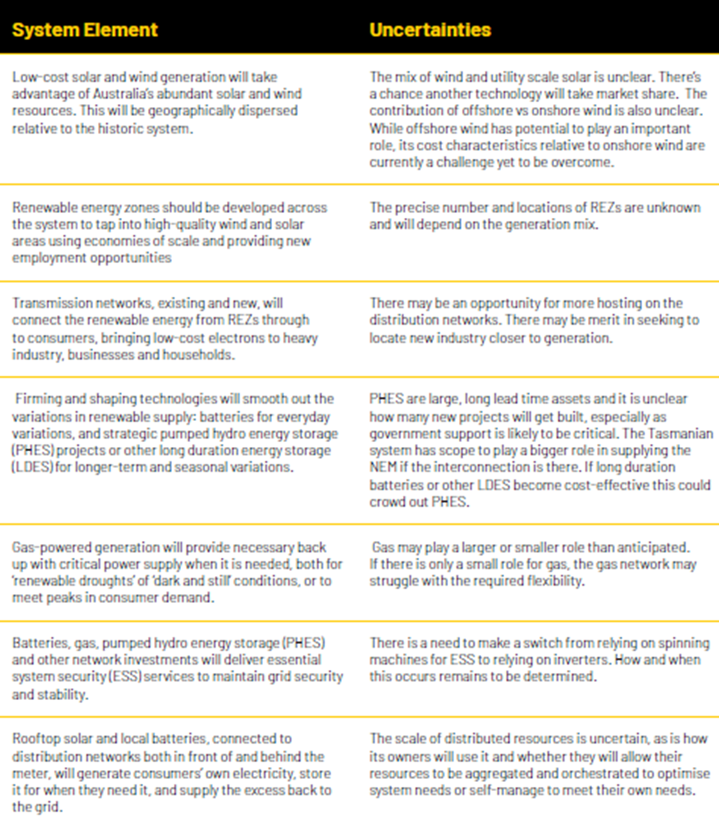
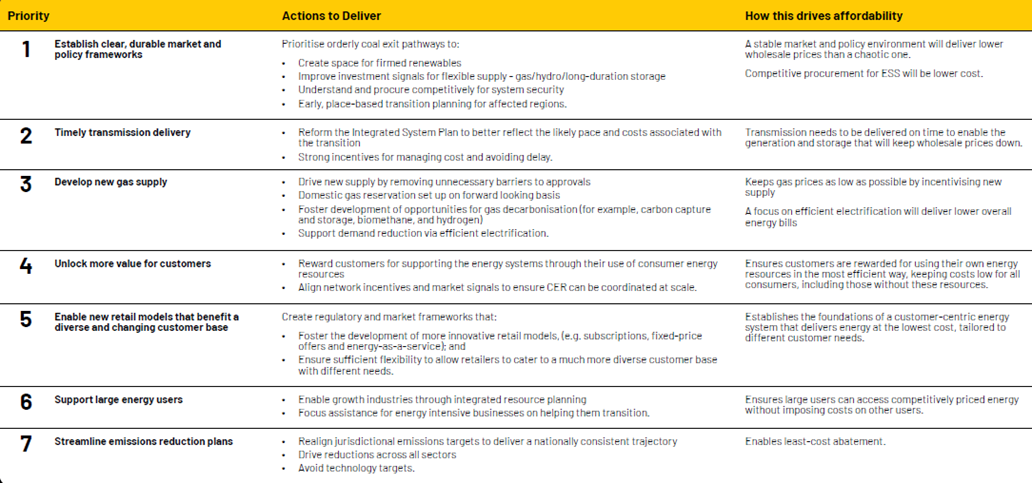
We also focussed on the seven critical enablers to support the energy transition, as shown in Table 2 below. We think a sustained focus on these critical enablers will be key to a successful transition.
Table 2: Priority actions
Our hopes for Energy2050 and what we plan to do next
The AEC hopes that Energy2050 can serve as a resource for industry, stakeholders and Government in thinking through the key priorities to manage the energy transition on behalf of consumers. I have mentioned a few times that members and stakeholders will see their ideas reflected in Energy2050, and that this document assists the industry in advocating for a successful energy transition and keeps us focused on the really critical enablers.
For our part, we plan to keep engaging using the insights and framing of Energy2050. We will use it in our submissions, in bilateral meetings, and have an upcoming AEC conference where we will gather to expand on the key themes. We are also keen to continue to focus on the progress against key transition metrics, with the AEC tracking some of those metrics with plans to report on an annual basis.
A successful transition will not be delivered unless we are intentional about creating a pathway to achieve net zero, and to enable this, we need to know what we are striving for. Energy2050 provides that light on the hill so that even in times of crisis and challenge we don't lose sight of what we are seeking to achieve - an affordable, secure and sustainable energy system for all Australians. I look forward to hearing your feedback, and working closely with you to see this vision delivered.
Read here:
National Electricity Market Report
South West Interconnected System Report
[1] https://www.unsw.edu.au/staff/john-fletcher
Related Analysis
Australia’s Home Battery Surge: A Question of Equity
Australia is a global leader in rooftop solar, with more than 4.3 million households and small businesses installing photovoltaic (PV) systems as of February 2026. Battery uptake has also accelerated, particularly since the introduction of the Cheaper Home Batteries Program in July 2025, which offers around a 30 per cent upfront discount for systems between 5 kWh and 100 kWh. More than 236,000 batteries had been installed by February 2026, although this likely understates the true figure due to reporting lags; the Federal Government has since indicated installations have surpassed 250,000 as of March 2026. Despite this rapid growth, an important question remains: who is actually benefiting from these subsidies?
South Australia’s election: a renewed Labor mandate or a history-making first for One Nation
As South Australia heads to the polls this Saturday, energy is shaping up as one of the key issues. The debate is being driven by two very different visions for the state’s future. Based on current polling, Peter Malinauskas’s Labor Government is expected to be re-elected, likely with an increased majority. However, it remains unclear who will form the opposition, with recent polling suggesting Pauline Hanson’s One Nation is currently favoured to take that role. This sets up the election as a clear comparison between two very different approaches to energy. Read more.
Clarity and understanding key ingredients for successful transition
The energy system is complex and decarbonising the grid adds further complexity. It requires significant new investment to ensure coal plants can exit without having an impact on the reliability of the grid. It comes with unavoidable costs and will take time to get right. It is increasingly important given this context that the energy transition is well understood. Selective framing of data to apportion blame works against a broad understanding and has the potential to undermine customer confidence and support for the transition. Read more.
Send an email with your question or comment, and include your name and a short message and we'll get back to you shortly.