




by Australian Energy Council
Clarity and understanding key ingredients for successful transition
The energy system is complex and decarbonising the grid adds further complexity. It is well understood by energy market participants, government, and regulators that the least cost pathway to net zero is a renewable energy system predominantly powered by wind and solar, firmed by gas, batteries and hydropower. It is a pathway that requires significant new investment, including largescale upgrades to existing infrastructure and the development of new infrastructure to ensure coal plants can exit without having an impact on the reliability of the grid. So, it comes with unavoidable costs and will take time to get right.
It is increasingly important given this context that the energy transition is well understood. Everyone with an interest in the decarbonisation of the energy sector, as well as government and regulators, have a role in helping build clarity and a rational understanding of the implications of the energy transition. In this environment, selective framing of data to apportion blame works against a broad understanding and has the potential to undermine customer confidence and support for the transition. That can only lead to a poorer outcome for all energy sector participants and consumers.
Market Insights
When considering the dynamics at work in the National Electricity Market (NEM), the Australian Energy Market Operator’s quarterly energy market reports provide good insights into supply and demand, as well as the factors at play in wholesale spot prices. Equally, the Australian Energy Regulator’s reports including those into high price events provide insights into the often multiplicity of factors behind price spikes. In contrast, a recent report[i] from climate lobby group, the Climate Council, seeks to apportion blame for high power prices to just some of the factors at play – specifically coal, gas and retail margins.
That report does not allow for the complexities of a grid in transition and the vagaries of the generation mix. It also does not acknowledge that what we are seeing with higher prices often simply reflects the realities of an energy-only market like the National Electricity Market (NEM). Periods of very high wholesale prices are (and have always been) an inherent feature of the NEM, they are part of how the design is intended to work. High prices during supply scarcity events act to:
- Provide revenue to peaking generators (increasingly this includes batteries discharging, as well as more traditional gas peaking plants) that operate only occasionally to maintain reliability;
- Signal the need for new investment; or,
- Encourage demand response.
The NEM is indifferent to technology type. It seeks to find the most efficient way of supplying electricity demand at any given time, given the suite of available generation bidding in. If higher prices are sustained, then that becomes a signal for potential investors to build new generation. Similarly, if low spot wholesale prices are sustained, this is a signal for marginal generators to exit the market.
Wholesale spot prices are not the full picture either. Behind spot prices another complex set of forward contract markets exist which generators and buyers enter to hedge the risk of these often-volatile spot markets, and in that way, protect consumers from price volatility.
The Climate Council report points to gas as the main reason for high electricity prices on the stated basis that it sets the price up to 90 per cent of the time. The research that is referenced in the report for this figure has more variance and states gas can set the price between 50 and 90 per cent of the time. Gas generation is expensive but the amount of time it sets the price for a specific NEM region will, and does, vary depending on a range of factors. The report sees gas as a problem while system planners view it as ‘an indispensable last line of defence’[ii] in maintaining system security’ and part of a successful transition to a renewables-dominated grid.
The main objective of energy policy is to minimise power system costs while ensuring reliability and sustainability. Reliability is “met by an optimal mix of plant including a suitable reserve plant margin”[iii].
Gas plays a critical role in this regard and as noted in this Cambridge University Energy Policy Research Group paper by Professor Paul Simshauser[iv] gas turbines (GT) can also frequently be the least cost option to maintaining system security:
“During episodic periods of very low solar and wind – a common occurrence during winter months – stored energy in batteries can be quickly exhausted. At this point, some form of dispatchable generation without an energy constraint is required. For this purpose, the GT is frequently a least cost option. Their comparatively low capital cost (with high marginal running costs) makes GTs ideally suited to peaking duties.”
While gas is often the marginal generator, we are also seeing grid-scale batteries increasingly playing the price setting role in the NEM (which is also noted in the Climate Change report). AEMO’s Q1 2025 Quarterly Energy Dynamics report noted that batteries increased their price setting frequency (4 per cent from discharge and 6 per cent for battery load when charging) during the period, while by this had increased to 11 per cent (discharge) and 9 per cent (charge)[v]. Interestingly, hydro set the price most frequently in the fourth quarter 2025 (see figure 1).
The AER has also noted the trend. Batteries are becoming the marginal unit that determines the spot price and we can expect that to grow as more batteries come online.
While batteries continue to be the price setter in a relatively small number of periods, their average spot price, like gas, can be high. In Q4 2024 batteries’ involvement in price setting during peak high-priced volatility periods “led to the largest year-on-year growth in average price set for any source, averaging $309/MWh”, according to AEMO.
In contrast, in Q4 2025 AEMO reported that increased wind generation and battery discharge, particularly in the evening peaks, reduced reliance on gas and hydro generation in those periods, contributing to lower average prices and the reduced incidence of high-priced intervals.
Figure 1: NEM Price Setting Frequency and Average Spot Price by Fuel Type
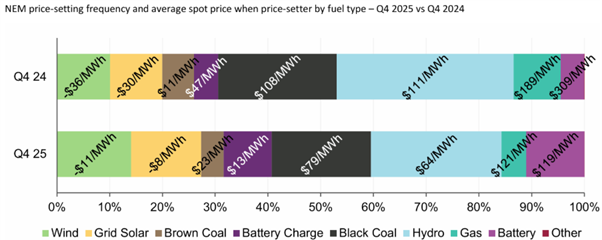
Source: AEMO QED Q4 2025
Singling out any technology as the culprit in high price events is unhelpful and doesn’t provide a full picture, particularly when considering an energy-only market and the dynamics involved in the energy transition. The generation type involved in price setting will change as the transition continues. Energy costs are increasing as we navigate through the energy transition, replacing up to 60 per cent of our generation fleet while investing in a system capable of supporting large volumes of renewable energy.
The Climate Change report also attributes the largest electricity price spikes to aging coal plants, whilespecifically highlighting the availability of the Eraring Power Station. It also notes that units can be offline for more than eight months a year. The plant recorded an availability factor of 79 per cent in the 2025 financial year.
Eraring also plays an important role in the NSW grid in supporting its shift to more renewables. This was noted by the State Government when Origin announced Eraring would remain the market until 2029: “Origin’s decision gives certainty to workers, the market and energy consumers across the state, as well as contributing to NSW’s 2030 emissions reduction target.”[vi]
The NSW Government further noted that it had previously entered an agreement with Origin Energy over Eraring to “ensure energy reliability and avoid price spikes for households and businesses”.
The decision of the NSW and Victorian governments to enter arrangements with coal plants is based on a pragmatic and realistic assessment of the state of the transition. As the grid transitions to a renewables-dominant energy system, thermal generation will continue to play a critical role in maintaining stability and reliability, until we have fully firmed renewables, particularly during periods of high demand when the wind isn’t blowing and the sun isn’t shining.
The Climate Council’s report also seeks to blame energy retailers for high prices. It points to ‘huge profits’ from retail margins yet reports retail margins represent just 6 per cent of a customer’s power bill. And notably, the most recent Australian Competition and Consumer Commission report on the retail market found the majority of consumers still pay less than what the AER considers to be a reasonable price, which is represented by its Default Market Offer (DMO). The reportalso seeks to portray the biggest retailers as the country’s biggest carbon emitters. It ignores the fact that those same companies have committed to closing their coal plant and are amongst the biggest investors in the energy transition.
Our members are investing hundreds of millions of dollars on batteries, pumped hydro projects, as well as wind and solar farms, and also supporting other renewable projects through investment in power purchase agreements.
Just a few examples:
- Stage 1 (460MW) of Origin’s Eraring big battery began commercial operations early this year and stage 2 will add 240MW. In total Origin is aiming for a battery portfolio of more than 1.5GW.
- It has developed other batteries at Mortlake (~300 MW / 650 MWh) and Summerfield (~240 MW / 480 MWh).
- AGL has developed the 250MW Torrents Island Big Battery in South Australia.
- Construction has started on AGL’s Tomago Battery (500 MW) and a 500MW battery at the former Liddell Power Station site in NSW.
- AGL is a joint venture partner in the Pottinger Wind Farm (~1,300 MW) with a 500 MW battery, which has received federal approval.
- AGL is involved in a range of hydro power plants.
- EnergyAustralia is developing the Wooreen Energy Storage System in Victoria, a 350 MW, utility-scale battery in the Latrobe Valley.
- It has also contracted the dispatch rights from the Kidston Pumped Hydro Energy Storage project and entered an offtake agreement for the Orana Battery Energy Storage System (BESS).
[i] Power Games: Who’s Driving High Power Bills, Climate Council
[iv] Paul Simshauser is a Professor of Economics at Griffith University’s Centre for Applied Energy Economics & Policy Research. He is also Chief Executive Officer of Iberdrola Australia.
[vi] Media Statement - Eraring Power Station | NSW Climate and Energy Action
Related Analysis
The GHG Protocol: make or break for green data centres?
In the past few months, data centres have received significant attention as potential beehives for renewable investment and an antidote to the much-publicised tenor gap. But some recent changes being discussed globally could complicate how businesses such as data centres purchase their electricity. If not navigated carefully, these changes could make the vision of 100 per cent renewable powered data centres a distant fantasy rather than a reality. Let’s take a closer look.
Joint AEC-CEC rule change to enhance system security frameworks
As the National Electricity Market accelerates its transition to higher levels of renewable energy, maintaining system security has become a critical challenge. In response, the Australian Energy Council and Clean Energy Council have lodged a joint rule change request to strengthen planning, governance and procurement frameworks for essential system services. The proposal aims to support an orderly transition while ensuring the grid remains secure and investable. Read more.
A New Year: New regulated offer; new records but some old challenges
A new year has brought major developments across Australia’s energy markets, with new regulatory interventions alongside record-breaking renewable generation. The Federal Government’s Solar Sharer Offer marks a significant shift in retail market design, while the wholesale market delivered historic renewable output and much lower prices, driven largely by strong wind and growing battery capacity. We take a look at what these changes mean for customers, retailers and the reliability of the power system, and where old challenges continue to resurface.
Send an email with your question or comment, and include your name and a short message and we'll get back to you shortly.