




by Carl Kitchen
A New Year: New regulated offer; new records but some old challenges
The beginning of the year has seen some significant energy developments in both the retail and wholesale markets.
On the retail front, the Federal Government released its Solar Sharer Offer Consultation outcome paper on 23 January. This follows a range of concerns being raised in submissions to the process. The outcome paper maps the Government’s proposed approach to the design and implementation of the SSO. The design principles it proposes include that it should consider retailer viability, have a reasonable use cap of 24kWh and be adaptable. It will be an “opt in” tariff and its effectiveness will be subject to a review no later than two years after its introduction. The overriding design principle in determining the SSO will be to ensure customers who shift load are better off overall. The AER has been tasked with adopting a methodology that considers how best to price the non-free-power periods to allow retailers to recover costs “where necessary”. Only retailers with less than 1000 customers are exempt from the new tariff.
While the government has taken on board some industry feedback in its outcomes paper, two key areas highlighted by retailers do not form part of the SSO response. Network tariffs remain unchanged, and there is no change to the tight implementation timeframe of 1 July 2026, despite the government acknowledging that it is ambitious. It puts pressure on the industry to implement what is a complex product in just 5 months.
While we can and do welcome the intent behind the offer, the Australian Energy Council remains concerned that the design has been rushed, which will limit its effectiveness, and for that reason, represents a missed opportunity. The current design means many customers are unlikely to see meaningful savings.
Mandating free retail power during some hours requires cross-subsidy of other costs, such as the network costs, wholesale costs and environmental costs that retailers will continue to incur during the free energy period.
The network “cost misalignment” will see retailers charged for the “free” energy they supply from the grid. Retailers forced to absorb these network costs, will have no choice but to recover them elsewhere and there is a real risk that energy charges outside the free window, such as during the evening peak, will be higher, which may disadvantage some customers.
Further reform to network tariffs will be required to better reflect how consumers use the system and to deliver fairer outcomes for both customers and retailers and to make the SSO more sustainable.
We are yet to see how the Australian Energy Regulator (AER) will set the parameters of the SSO based on the design principles, such as what costs it will allow retailers to recoup outside the free period.
Setting a reasonable use cap will be important. It can help ensure the financial costs are shared more fairly. Without a cap, a user with a large battery could import huge amounts of energy for $0, leaving other customers (like renters) to pick up the tab for the network delivery charges. The Government has nominated 24 kWh based on the Australian Energy Regulator’s Residential Energy Consumption Benchmarks report and is equivalent to an average five plus person household shifting its total daily electricity use in the free power periodi.
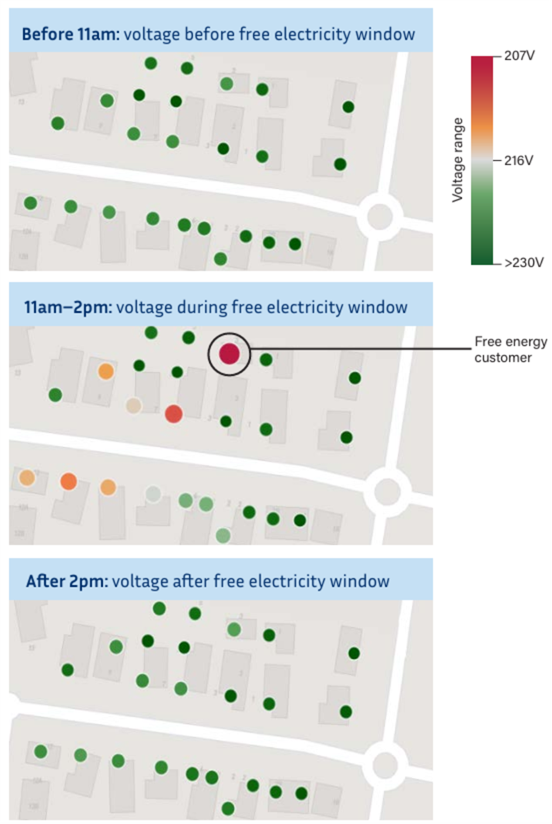
A reasonable daily limit is aimed at allowing a family to run ordinary household appliances, while limiting unfair cross-subsidies. A daily use limit could also assist to address concerns around localised voltage issues. Potential local voltage issues have been highlighted by the former CEO of Energy Networks Australia, Andrew Dillon, in this online article “No such thing as a free lunch hour”. Networks rely on diversified customer loads to operate effectively,ii and in Figure 1 below have illustrated the voltage impacts from the actions of a customer increasing consumption in the free energy period in local area.
Figure 1: Voltage impacts during free electricity period
Source: Citipower, Powercor DSO Vision
The potential extent of the issue is not known because it is hard to estimate how many customers will move to the new offer, how the Australian Energy Regulator (AER) determines the free-power period and weighs the various factors or how effective mechanisms like the reasonable use cap will be.
Renewables “Landmark Moment”
The release of the Australian Energy Market Operator’s (AEMO) latest quarterly energy dynamics report in January (covering the last quarter of 2025) showed record generation from renewables, which supplied more than half of total energy needs for the first time.
Wind generation was up 29 per cent and averaged 4092 MW, grid-scale solar was up 15 per cent (2535 MW) and battery discharge nearly trebled, hitting an average of 268 MW. Rooftop solar hit a new record output of 4407 MW.
The quarter also reported much lower wholesale prices, averaging $50/MWh across the National Electricity Market (NEM), and 44 per cent lower than the corresponding quarter in 2024.
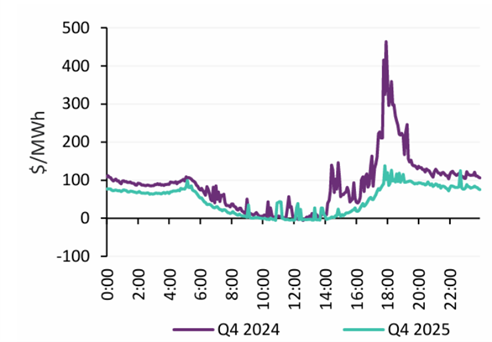
The latest QED highlights the value of having sufficient wind in the grid to complement solar and other generation, as well as increased battery storage. An important element in the price outcomes was the availability of wind and grid-scale battery capacity at peak periods and particularly in the evening peak. While NEM average prices fell across most of the day compared to Q4 2024, the largest reductions were seen in the evening peak (see figure 2)
Figure 2 NEM Average Spot Price by Time of Day – Q4 2024 v Q4 2025
Source: AEMO QED Q4 2025
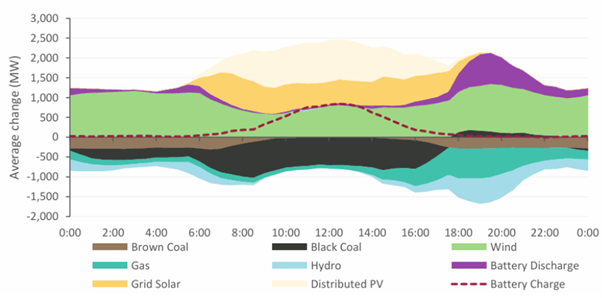
As noted in the QED: “During the morning peak (0600 hrs-1000 hrs), wind generation rose by 706 MW (+26%) and grid-scale solar output was up by 686 MW (+16%), resulting in a year-on-year decrease in coal and gas-fired generation. During the evening peak (1600 hrs-2000 hrs), wind generation surged by 1,030 MW (+30%), while battery discharge increased by 486 MW (+175%), reducing the dispatch of gas and hydro generation. These outcomes led to a significant reduction in price volatility compared to Q4 2024.”
The following graph shows the NEM change in fuel mix by time of day between Q4 2025 and Q4 2024 and the increase in wind and battery discharge at peak times.
Figure 3 Change in Fuel Mix by Time of Day (Q4 20024-Q4 2025)
Source: AEMO QED Q4 2025
In the fourth quarter of last year, the average renewable contribution to daily maximum demand increased to 36.6 per cent, up from 31.9 per cent in Q4 2024. Again this was primarily the result of the higher wind availability and increased battery discharge. Overall, the renewable contribution to daily maximum demand reached as high as 46.5 per cent.
Reliability and System Security
Ensuring sufficient generation at peak times to guarantee system security was behind the decision of Origin Energy to extend the operation of the Eraring Power Station in New South Wales. The power plant which was set to close on 19 August 2027 will now operate until 30 April 2029.
Origin Energy’s Chief Executive Officer, Frank Calabria, said while good progress was being made on the delivery of new energy infrastructure, including major transmission works and projects like Origin’s large-scale battery at Eraring, “it has become clear Eraring Power Station will need to run for longer to support secure and stable power supply”.
Energy security services have historically been provided by thermal plant and as large coal-fired generators retire, transmission companies have been investing in replacement technologies such as synchronous condensers.
AEMO’s Transition Plan for System Security highlighted risks to system security in NSW without having Eraring available. While Transgrid is progressing the procurement of a series of synchronous condensers, they are not scheduled to be operational until 2028, despite attempts to fast track them. The infrastructure faces supply chain constraints, project delays and “other risks”.
The exit of Eraring Power Station before these synchronous condensers are operational could challenge system strength and inertia in New South Wales. Aside from keeping coal plant in the system and depending on synchronous condensers there may also be a role for other technologies in the future, such as grid-forming inverters, gas-fired generators with clutches and large inverter-based loads. The AEC, along with the Clean Energy Council, has submitted a rule change seeking to enhance system security frameworks.
System security was also a factor in the WA Government’s announcement of an extension to the state agreement to support Griffin Coal’s Ewington coal mine operations at Collie, south of Perth. The agreement which was due to conclude on 30 June this year will be extended from July for up to five years to “provide energy security during the energy transition”. It will allow the mine to continue to supply industry and the Bluewaters Power Station.
While the State Government remains committed to closing state-owned plants in 2030 the Premier Roger Cook said: "Collie remains critical to our government's vision of becoming a renewable energy powerhouse, with coal fired power generation underpinning energy security and affordability as we build our major new transmission lines to connect large scale wind and solar to the grid.”
And this month WA’s ERA Economic Regulation Authority (ERA) released its draft determination for a Benchmark Reserve Capacity Price of AU$491,700/MW per year for the 2028-29 capacity year, a 36 per cent increase on the previous price. The BRCPs are part of the state’s Reserve Capacity Mechanism which is designed to ensure adequate generation and storage capacity is available to meet demand.
The BRCP represents the estimated annual cost per megawatt (MW) of building and connecting a hypothetical new entrant capacity asset into the South West Interconnected System (SWIS). That “hypothetical new entrant” is the benchmark technology — currently a model battery energy storage system (BESS) — and is used to set the revenue signal for capacity providers across the market. Consumers ultimately fund the cost of the Reserve Capacity Mechanism through their electricity bills.
Related Analysis
South Australia’s election: a renewed Labor mandate or a history-making first for One Nation
As South Australia heads to the polls this Saturday, energy is shaping up as one of the key issues. The debate is being driven by two very different visions for the state’s future. Based on current polling, Peter Malinauskas’s Labor Government is expected to be re-elected, likely with an increased majority. However, it remains unclear who will form the opposition, with recent polling suggesting Pauline Hanson’s One Nation is currently favoured to take that role. This sets up the election as a clear comparison between two very different approaches to energy. Read more.
The Shadow of the Safety Net: Who Pays for Fairness?
Fairness is a defining Australian value, and it sits at the heart of Victoria’s Getting to Fair strategy aimed at improving equity in essential services. While the Australian Energy Council strongly supports helping people in vulnerable circumstances, funding social equity programs through energy bills risks creating hidden cross-subsidies that place additional pressure on households already struggling with affordability. We take a look at why a more transparent, tax-funded model, combined with retailers acting as delivery partners, may provide a more sustainable and genuinely fair pathway to supporting vulnerable customers.
Clarity and understanding key ingredients for successful transition
The energy system is complex and decarbonising the grid adds further complexity. It requires significant new investment to ensure coal plants can exit without having an impact on the reliability of the grid. It comes with unavoidable costs and will take time to get right. It is increasingly important given this context that the energy transition is well understood. Selective framing of data to apportion blame works against a broad understanding and has the potential to undermine customer confidence and support for the transition. Read more.
Send an email with your question or comment, and include your name and a short message and we'll get back to you shortly.